
Have you ever noticed that reading small text has become harder, lights look blurry at night, or straight lines appear slightly distorted when you look at them? Many adults in their 40s, 50s, and beyond experience vision changes, but it can be difficult to determine exactly what is causing them.
Table of Contents
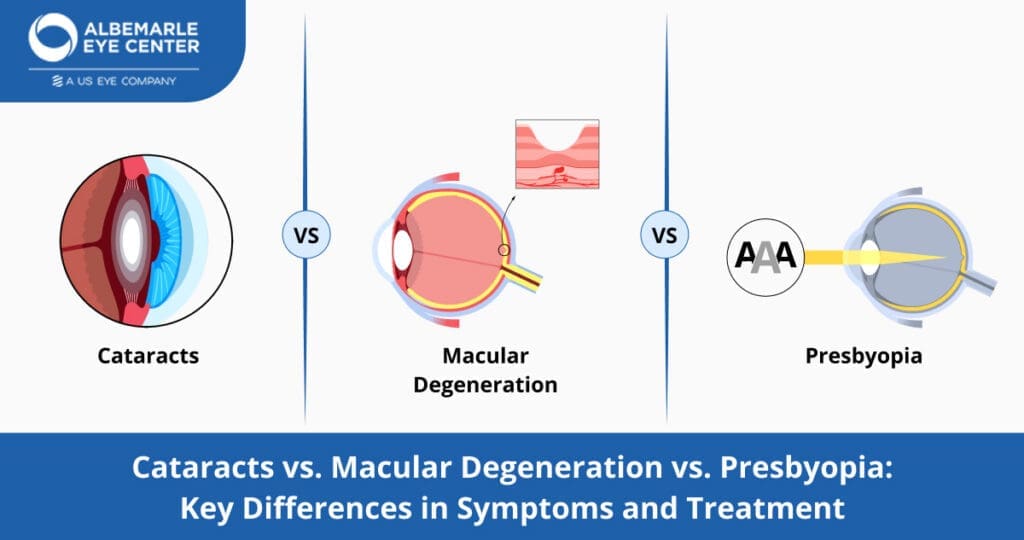
Several common age-related eye conditions affect vision over time, and three of the most frequently discussed are cataracts, macular degeneration, and presbyopia. Because they all occur with aging and affect sight in different ways, many people confuse them or assume they are the same condition.
Understanding cataracts vs macular degeneration and cataracts vs presbyopia is important for recognizing symptoms early and getting the right treatment. Each condition affects a different part of the eye, progresses at different rates, and requires a specific approach to care.
According to the National Eye Institute, more than 24 million Americans over age 40 have cataracts, and that number is expected to double by 2050. Meanwhile, age-related macular degeneration affects about 20 million people in the United States.
Knowing how these conditions differ can help protect your vision and prevent long-term damage.
Why These Eye Conditions Are Often Confused
Many people confuse cataracts, macular degeneration, and presbyopia because they develop gradually with age and affect daily vision tasks such as reading and driving. The symptoms can appear similar at first. However, each condition impacts a different part of the eye and requires a different treatment approach.
Vision changes rarely happen suddenly. Instead, they slowly develop over the years. A person might first notice difficulty reading menus, glare from headlights, or blurry central vision. These symptoms often overlap, which is why people sometimes confuse macular degeneration with cataracts or wonder whether cataracts or presbyopia is the cause.
The confusion also stems from the fact that these conditions can occur simultaneously. Someone may develop presbyopia in their early 40s, cataracts in their 60s, and macular degeneration later in life.
Similar Early Symptoms
Some shared symptoms include:
- Blurry or cloudy vision
- Difficulty reading small print
- Trouble seeing in low light
- Glare from headlights or sunlight
Because these symptoms appear gradually, many people assume they simply need stronger glasses.
Aging as a Common Risk Factor
Age is the biggest risk factor for these common age-related eye conditions. As the body ages, the structures inside the eye naturally change.
For example:
- The lens can become cloudy.
- The retina can weaken.
- The eye can lose its ability to focus on close objects.
These normal aging changes explain why so many adults experience vision problems later in life.
Quick Fact – The Centers for Disease Control and Prevention reports that vision impairment affects over 12 million people aged 40 and older in the United States.
What Are Cataracts?
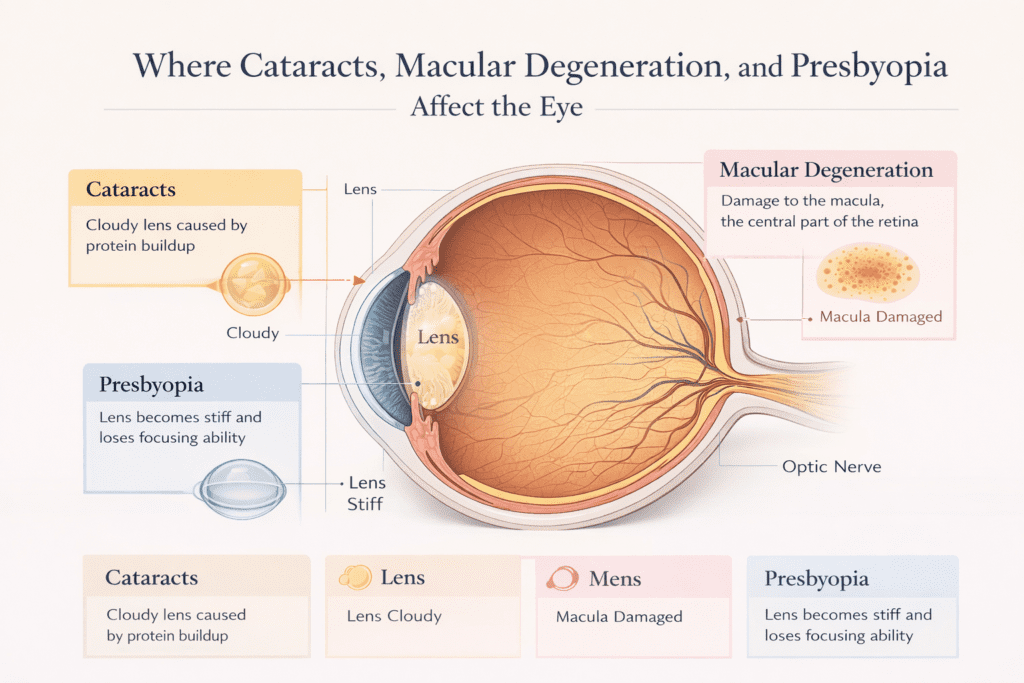
Cataracts occur when the natural lens of the eye becomes cloudy, preventing light from passing clearly to the retina. This leads to blurry or dim vision. Cataracts develop slowly and are one of the most treatable eye conditions.
Understanding cataracts vs macular degeneration begins with knowing how cataracts affect vision.
The eye has a clear lens behind the iris. This lens focuses light onto the retina, making images appear sharp. Over time, proteins inside the lens begin to break down and clump together. This creates cloudiness that blocks light.
Common Symptoms of Cataracts
People with cataracts often notice:
- Blurry or cloudy vision
- Increased sensitivity to light
- Halos around lights at night
- Faded or yellowed colors
- Frequent changes in glasses prescription
Many people first notice problems when driving at night because headlights appear very bright or scattered.
Read More: Signs You May Be Suffering from Cataracts
Who Is at Risk?
Cataracts become more common with age. Risk factors include:
- Aging over 60
- Diabetes
- Smoking
- Long-term sun exposure
- Eye injuries
Tip – Wearing UV-blocking sunglasses can help slow the development of cataracts by protecting the lens from sunlight damage.
Treatment Options
Early cataracts can sometimes be managed with stronger glasses or brighter lighting. However, once vision becomes significantly affected, surgery is the most effective treatment.
Modern procedures replace the cloudy lens with a clear artificial lens. Today’s techniques allow patients to recover quickly and restore clearer vision.
What Is Macular Degeneration?
Macular degeneration is a disease that affects the macula, the central part of the retina responsible for sharp vision. It causes distortion or loss of central vision while peripheral vision remains intact. The condition mainly affects older adults.
Understanding macular degeneration and cataracts is important because the two conditions affect completely different parts of the eye.
While cataracts affect the lens, macular degeneration damages the retina.
What Is the Macula?
The macula is a small but extremely important area in the center of the retina. It allows you to:
- Read fine print
- Recognize faces
- Drive safely
- See small details clearly
When the macula becomes damaged, central vision becomes distorted or blurry.
Types of Macular Degeneration
There are two main types.
- Dry Macular Degeneration – This is the most common form. It happens when the macula becomes thinner with age.
- Wet Macular Degeneration – This occurs when abnormal blood vessels grow under the retina and leak fluid.
Key Symptoms
Symptoms may include:
- Blurry central vision
- Straight lines appear wavy
- Dark or empty spots in the center of vision
- Difficulty recognizing faces
Unlike cataracts, this condition does not cause cloudiness across the entire field of vision.
What Is Presbyopia?
Presbyopia is a natural age-related condition that reduces the eye’s ability to focus on close objects. It typically begins in the early to mid-40s. Reading glasses or corrective lenses are the most common solutions.
When people compare cataracts vs. presbyopia, they often want to understand why reading small text suddenly becomes difficult.
Presbyopia happens because the lens inside the eye becomes less flexible over time.
How the Eye Focuses
The eye normally changes focus by adjusting the shape of the lens. This process allows people to switch between seeing far and near objects clearly.
With age, the lens becomes stiffer and less able to change shape.
Common Symptoms
Signs of presbyopia include:
- Difficulty reading small text
- Holding books farther away
- Eye strain when reading
- Headaches after close work
These symptoms typically begin around age 40.
Tip – Good lighting can make reading easier for people with presbyopia because brighter light improves focus.
Treatment Options
Most people manage presbyopia with:
- Reading glasses
- Bifocal lenses
- Progressive lenses
- Contact lenses
Unlike other eye diseases, presbyopia does not damage the eye itself.
| Feature | Cataracts | Macular Degeneration | Presbyopia |
| Part of the eye is affected | The eye lens becomes cloudy | Macula (the central part of the retina) becomes damaged | The eye lens loses flexibility |
| Main Cause | Protein buildup in the lens due to aging | Degeneration of retinal cells related to aging | Natural aging process that reduces focusing ability |
| Vision Problem | Blurry or cloudy overall vision | Distorted or missing central vision | Difficulty focusing on close objects |
| Typical Age of Onset | Usually, after age 60 | Usually, after age 60 | Usually begins around age 40 |
| How Vision Changes | Vision looks foggy or dull | Straight lines appear wavy, and central vision fades | Reading small text becomes difficult |
| Peripheral Vision | Usually unaffected | Peripheral vision usually remains normal | Peripheral vision remains normal |
| Progression Speed | Develops slowly over the years | Dry form progresses slowly; wet form can progress quickly | Gradual progression over time |
| Common Symptoms | Glare from lights, halos, faded colors | Dark spots in central vision, difficulty recognizing faces | Holding reading material farther away |
| Diagnosis Method | Eye exam and lens examination | Dilated retinal exam and imaging tests | Vision test during a routine eye exam |
| Treatment Options | Surgical lens replacement when vision worsens | Medications or injections for some forms | Reading glasses or corrective lenses |
| Impact on Daily Life | Difficulty driving at night and reading | Trouble recognizing faces or reading | Difficulty reading phones, menus, or books |
| Reversibility | Vision restored after surgery | Vision loss may be slowed but not fully reversed | Managed with glasses or lenses |
How Doctors Diagnose Each Condition
Eye doctors use specialized exams and imaging tests to determine the exact cause of vision changes. Accurate diagnosis is essential because each condition requires a different treatment plan.
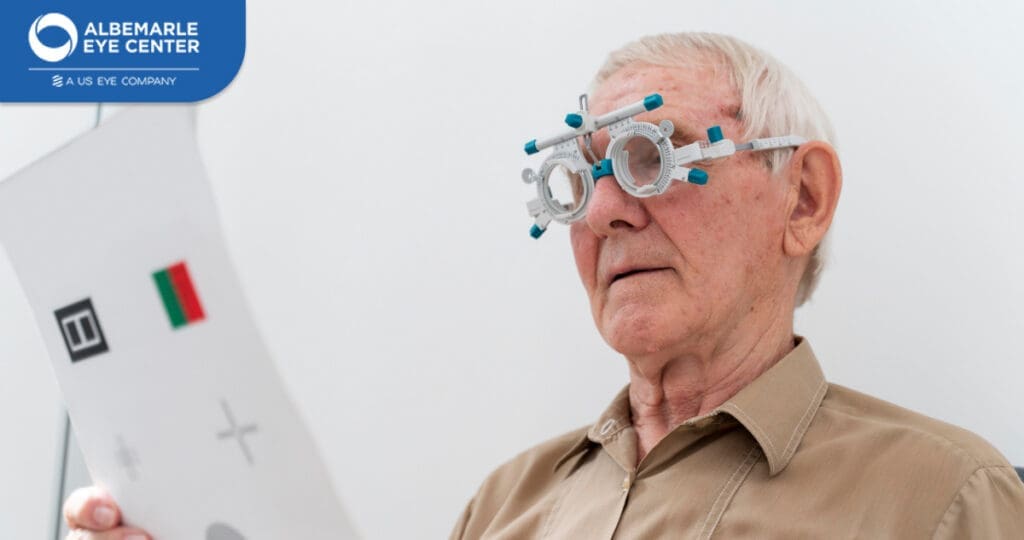
A comprehensive eye exam enables doctors and cataract surgeons to evaluate the entire eye.
Common Diagnostic Tests
These may include:
- Visual Acuity Test – Measures how clearly you can see letters at different distances.
- Dilated Eye Exam – Drops widen the pupil so doctors can examine the retina and lens.
- Optical Coherence Tomography (OCT) – Provides detailed images of the retina to detect macular degeneration.
Quick Fact – Regular eye exams can detect many vision problems before symptoms become severe. Even the American Optometric Association recommends that adults over 60 have an eye exam every year.
When to See an Eye Doctor Immediately
Some vision changes should never be ignored. Sudden symptoms may indicate serious eye conditions that require immediate medical attention.
You should seek immediate care if you experience:
- Sudden loss of vision
- Distorted or wavy lines
- Dark spots in central vision
- Flashes of light
- Severe eye pain
These symptoms could indicate retinal damage or advanced macular degeneration.
Early treatment can help prevent permanent vision loss.
Key Takeaways
- Many people confuse cataracts vs macular degeneration because both affect vision later in life.
- Cataracts cause cloudy vision due to changes in the eye’s lens.
- Macular degeneration damages the retina and affects central vision.
- Presbyopia affects the eye’s ability to focus on nearby objects.
- Regular eye exams help detect common age-related eye conditions early.
Conclusion
Vision changes are a natural part of aging, but understanding what is happening inside the eye can make a big difference in protecting long-term sight. When people learn about cataracts vs presbyopia or compare macular degeneration vs cataracts, they begin to recognize that these conditions affect different structures of the eye and require different treatment approaches.
Cataracts affect the lens’s clarity, macular degeneration affects the retina, and presbyopia reduces the eye’s ability to focus on close objects. Because these problems develop gradually, many people delay getting help until their vision becomes significantly impaired.
That is why routine eye exams and early treatment are so important.
At Albemarle Eye Center, patients receive advanced eye care using modern diagnostic technology and personalized treatment plans. The clinic has served communities across North Carolina for decades and focuses on protecting long-term vision through comprehensive care.
Their experienced ophthalmologists provide medical and surgical eye treatments, including advanced procedures to restore clear vision.
Frequently Asked Questions
Can someone have cataracts and macular degeneration at the same time?
Yes. Many older adults develop multiple age-related eye conditions simultaneously, which is why professional diagnosis is important.
Are cataracts preventable?
While aging is the main cause, wearing sunglasses, managing diabetes, and avoiding smoking may reduce risk.
Can macular degeneration be cured?
There is currently no cure for the dry form, but treatments can slow progression and preserve vision.
Does presbyopia continue to worsen over time?
Yes. Presbyopia gradually progresses until about age 65, when focusing ability stabilizes.
How often should adults over 60 get eye exams?
Most experts recommend yearly exams to detect early signs of vision loss.
Ready to Protect Your Vision and See Clearly Again?
If cloudy vision, reading difficulty, or vision distortion is affecting your daily life, it may be time to speak with an experienced eye specialist.
The team at Albemarle Eye Center includes highly trained doctors who provide advanced care and treatment for age-related eye conditions. Patients have access to modern procedures performed at a dedicated laser cataract surgery center, offering precise treatment options designed to restore clearer vision.
If you are considering laser cataract eye surgery or want to understand your treatment options, the best step is to schedule a professional consultation.
Visit the Albemarle Eye Center to schedule your eye exam and learn how expert care can help protect your vision for years to come.
Your eyesight is one of your most valuable senses, so why wait to take care of it?