
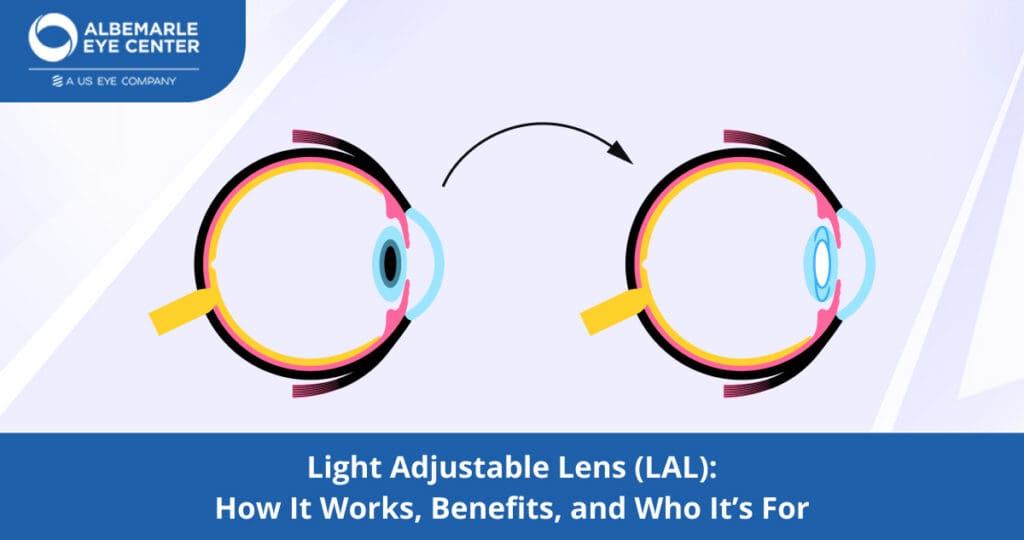
Are you worried that after cataract surgery, your vision may still not be exactly how you want it? Many people feel nervous before surgery because once a standard lens is placed in the eye, it cannot be changed. But what if your vision could be adjusted after surgery? What if your lens power could be fine-tuned based on how your eyes actually heal?
Table of Contents
That is where the light adjustable intraocular lens changes everything.
Cataracts are very common in the United States. According to the National Eye Institute, more than 24 million Americans aged 40 and older have cataracts, and that number is expected to grow to over 50 million by 2050. Cataract surgery is one of the most performed surgeries in the country. Because so many people need surgery, choosing the right cataract surgery lens options is more important than ever.
In this guide, you will learn how the UV light adjustment lens works, what makes it different from other lenses, who benefits most, and why it may be the most advanced option available today.
How the Light Adjustable Intraocular Lens Works?
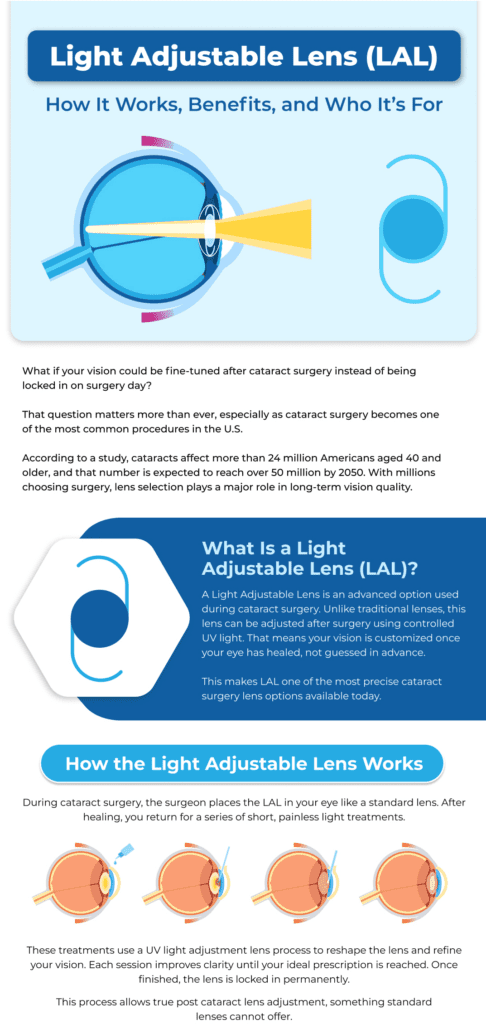
The light adjustable intraocular lens is a special type of lens used during cataract surgery that allows vision to be adjusted after surgery using controlled ultraviolet light treatments. Unlike traditional lenses, its power can be modified based on your real-world vision results.
This technology uses a photosensitive material inside the lens. After your eye heals, your surgeon applies targeted UV light to reshape the lens power. This allows customized correction for nearsightedness, farsightedness, and even astigmatism.
The Science Behind the UV Light Adjustment Lens
The UV light adjustment lens is made of a special photosensitive silicone material. Inside the lens are light-reactive molecules. When controlled UV light is applied, those molecules move and reshape the lens curvature.
This process changes how light focuses on your retina. Here is what happens step by step:
- Cataract surgery is performed, and the light adjustable intraocular lens is implanted.
- Your eye heals for about 2–3 weeks.
- Your vision is tested in real-life conditions.
- If adjustment is needed, the doctor uses a special UV light device.
- The lens shape changes to refine your prescription.
- After final adjustments, the lens is permanently locked in.
This is why it is called a UV light adjustment lens because ultraviolet light is used to customize your outcome.
Why Is This Different From Other Cataract Surgery Lens Options?
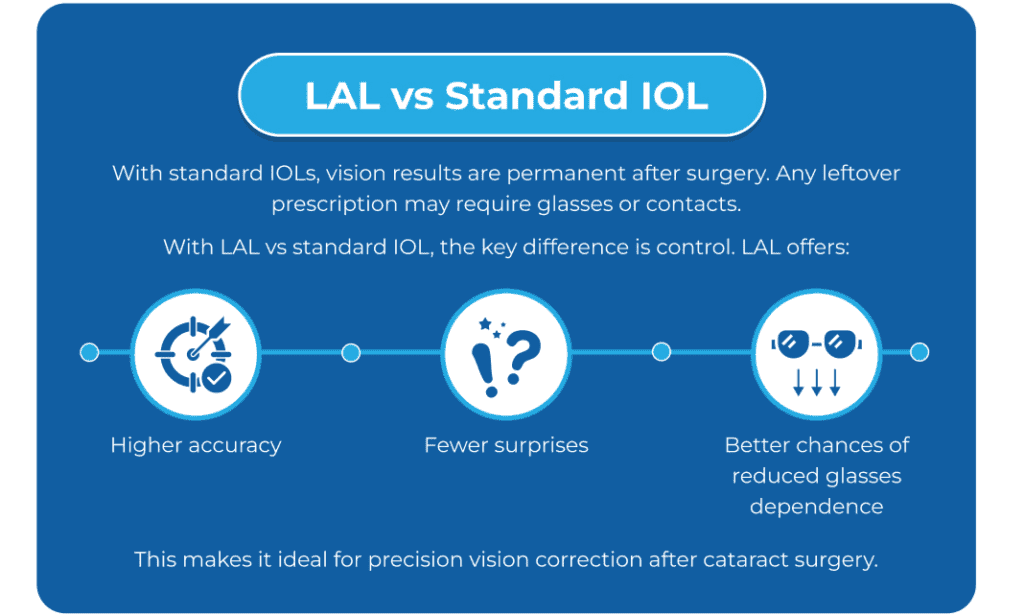
Traditional cataract surgery lens options require doctors to calculate lens power before surgery. These calculations are very accurate, but they are still predictions.
Healing differences, corneal shape, and prior surgeries can affect final vision.
With a light adjustable intraocular lens, your surgeon does not have to rely only on predictions. Your vision can be optimized after surgery.
That is a major shift in cataract surgery technology.
Why Precision Matters in Cataract Surgery?
Cataract surgery today is not just about removing cloudy vision. Patients expect clear, sharp, glasses-free vision.
According to the American Academy of Ophthalmology, over 3.7 million cataract surgeries are performed annually in the U.S. Even a small percentage of patients needing glasses afterward equals hundreds of thousands of people.
The light adjustable intraocular lens helps reduce this uncertainty.
The Limits of Standard Cataract Surgery Lens Options
Standard lens options include:
- Monofocal lenses
- Multifocal lenses
- Toric lenses
Each type has strengths. But once implanted, they cannot be modified. Even with advanced measurements, small refractive errors may remain.
That is why many patients still need glasses after surgery.
How the UV Light Adjustment Lens Improves Accuracy?
The UV lens allows:
- Fine-tuning sphere power
- Correction of residual astigmatism
- Personalization based on real-life activities
For example: You may think you want perfect distance vision. But after surgery, you realize you prefer slight near vision for reading. The light adjustable intraocular lens allows this customization.
That flexibility is powerful.
Who Is the Best Candidate for a Light Adjustable Intraocular Lens?
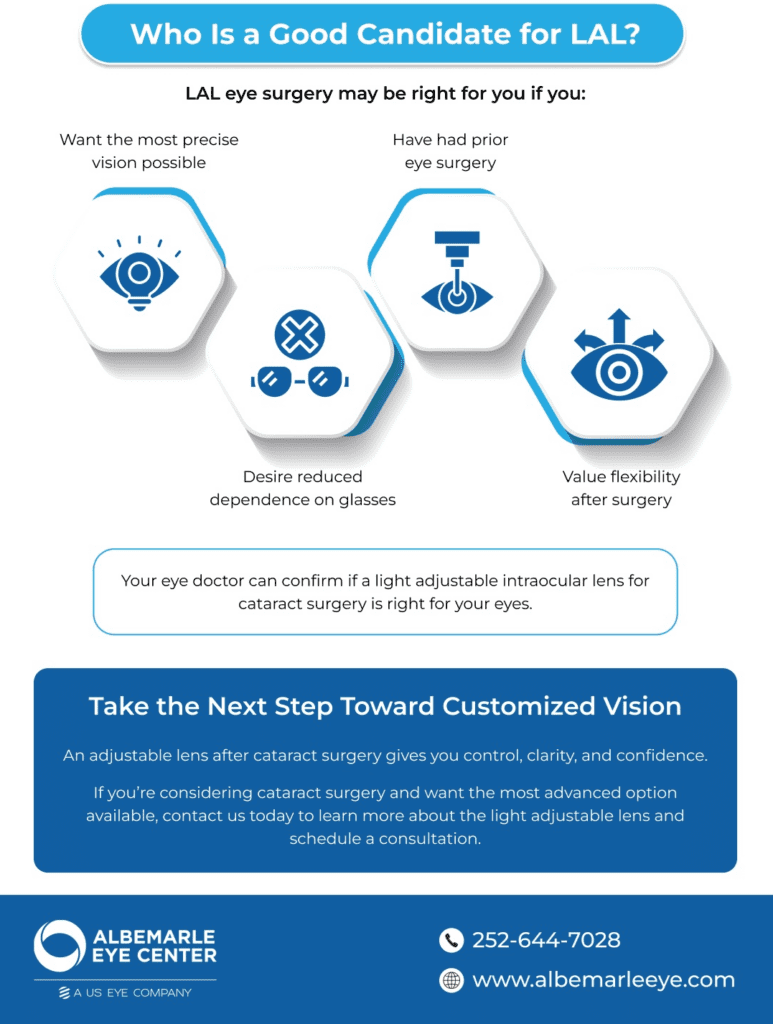
The light adjustable intraocular lens is ideal for patients who want highly precise results and are willing to attend follow-up visits for adjustments.
It is especially helpful for people with prior LASIK or PRK, irregular corneas, or unpredictable healing patterns.
Patients who desire reduced dependence on glasses often benefit the most from this technology.
Patients With Previous LASIK or PRK
Standard lens options can be harder to calculate in patients who had LASIK or PRK because the cornea has been reshaped. The UV light adjustment lens allows vision to be fine-tuned after surgery, reducing the risk of unexpected results.
Patients Who Want Maximum Customization
If you want sharp, personalized vision and more control over your final outcome, the light adjustable intraocular lens offers flexibility that fixed lenses cannot provide.
Patients Ready for the Follow-Up Process
You must wear UV-protective glasses and attend light treatment visits until the lens is locked. This short-term commitment helps ensure the best long-term results.
Benefits of the Light Adjustable Intraocular Lens
The light adjustable intraocular lens provides advantages that traditional cataract surgery lens options cannot offer.
It gives you control after surgery, improves refractive precision, and reduces dependency on glasses.
It represents a new era of adjustable cataract surgery.
- Post-Surgery Vision Customization – The main benefit of the UV light adjustment lens is customization after healing. Instead of guessing before surgery, your vision is refined after your eyes settle.
- Higher Chance of Achieving Target Vision – Studies published by peer-reviewed ophthalmology journals show higher rates of patients reaching 20/20 uncorrected vision compared to standard lenses. Because the light adjustable intraocular lens can be adjusted, outcomes are more precise.
- Reduced Need for Glasses – Many patients achieve functional distance vision without glasses.
Compared to other lens options, the adjustability improves independence.
Technical Advantages Over Standard Cataract Surgery Lens Options
The light adjustable intraocular lens uses advanced polymer chemistry and digital UV calibration systems to achieve accuracy that fixed lenses cannot match.
The adjustment process changes lens curvature at a microscopic level. This shifts focal power in controlled increments. It is one of the only cataract surgery lens options that can be modified after implantation.
Adjustment Range and Accuracy
The UV light adjustment lens can correct approximately:
- Up to 2.00 diopters of sphere
- Up to 2.00 diopters of cylinder (astigmatism)
This provides flexibility that other lens options cannot provide once surgery is completed.
Lock-In Mechanism
After adjustments, UV treatments “lock in” the lens configuration permanently. The light adjustable intraocular lens then behaves like a stable, fixed implant.
What to Expect During the Process
The light adjustable intraocular lens process includes surgery, healing, adjustments, and final lock-in. It requires more visits than standard lens options but offers higher precision. Patients should expect 2–4 light treatments spaced several days apart.
- After Surgery – You will wear UV-protective glasses at all times to prevent unintended light exposure.
- Adjustment Visits – Each UV light adjustment lens treatment lasts only a few minutes and is painless. Your doctor measures vision, applies UV light, and refines the lens.
- Final Lock-In – Once satisfied, the final light treatment permanently sets the light adjustable intraocular lens.
Key Takeaways
- The light adjustable intraocular lens allows post-surgery vision customization.
- It improves accuracy compared to traditional cataract surgery lens options.
- The UV light adjustment lens uses ultraviolet light to refine lens power.
- Ideal for patients wanting precise, personalized results.
- Especially helpful for patients with prior LASIK.
Conclusion
Choosing between different cataract surgery lens options can feel overwhelming. But today, you are not limited to fixed outcomes.
The light adjustable intraocular lens offers a level of customization that changes how we think about cataract surgery. By using a UV light adjustment lens, your vision can be fine-tuned after healing, not just predicted before surgery.
At Albemarle Eye Center, patient-centered care, advanced diagnostic technology, and personalized treatment planning guide every surgical decision. With decades of experience serving communities in North Carolina, their team focuses on precision, safety, and long-term vision quality.
If you are exploring a light adjustable lens or considering light adjustable and lens cataract surgery, your next step is simple.
Frequently Asked Questions
Is the light adjustable lens safe?
Yes, the light adjustable lens is FDA-approved and considered safe when used as directed. Most patients tolerate the procedure well, but as with any surgery, there are risks such as infection or inflammation. Your doctor will review all safety protocols and potential side effects during your consultation.
How long does the adjustment process take from start to finish?
The entire adjustment process typically takes 3–6 weeks. After your initial surgery and healing period, you’ll have 2–4 adjustment sessions, spaced several days apart, followed by a final “lock-in” treatment.
Will I feel pain during the UV light adjustment treatments?
No, the UV light adjustment sessions are painless. Numbing eye drops are used to keep you comfortable. You may feel mild pressure or light sensitivity, but most patients tolerate the process easily.
Can both eyes receive a light adjustable lens at the same time?
Usually, surgeons treat one eye at a time to ensure the best healing and adjustment outcomes. The second eye can be treated after the first has completed its adjustment and lock-in process.
What happens if I accidentally remove my UV-protective glasses before the lens is locked in?
Accidental removal of UV-protective glasses before the lens is locked in may expose the lens to unintended UV light, potentially affecting your vision outcome. If this happens, contact your eye doctor promptly for guidance and to assess if any corrective steps are needed.
Are You Ready to Schedule a Consultation?
If you want personalized guidance about your cataract surgery lens options, schedule a consultation today. Visit Albemarle Eye Center and contact our team to learn whether a light adjustable lens or light adjustable lens and cataract surgery is the right choice for your vision goals.
Your eyes deserve precision. Why settle for less?
**The information offered in this blog is not intended to substitute expert medical advice. Always seek a qualified healthcare professional for any questions or concerns you may have regarding your specific medical condition.**