
Table of Contents
Are you treating a serious eye condition with just a new pair of glasses?
Every May, Healthy Vision Month reminds Americans to take eye health seriously. Yet millions of people visit an optometrist when their symptoms already point to something that requires surgical evaluation. Knowing the difference and acting early can protect your sight permanently.
But first, how do you know when a routine eye exam with your optometrist is no longer enough?
What Is the Difference Between an Optometrist and an Eye Surgeon?
Many people assume both professionals do the same thing, but their roles are very different. While optometrists help manage routine vision care, eye surgeons diagnose and treat medical conditions that may permanently affect eyesight.
That said, optometrists and eye surgeons are not working in isolation. In a vertically integrated practice like Albemarle Eye Care, part of the US Eye network, the two specialties operate as one coordinated team. Patients move seamlessly from routine vision care to surgical evaluation without needing to chase down outside referrals, transfer records between offices, or repeat their history with a new provider.
Key Differences at a Glance
- Optometrists primarily focus on routine eye exams, prescription glasses, contact lenses, and early vision screenings.
- Eye surgeons (ophthalmologists) are medical doctors trained to diagnose eye disease, perform surgery, and manage complex eye conditions.
- Conditions like cataracts, glaucoma, retinal disease, and corneal disorders often require surgical or medical treatment beyond corrective lenses.
- Early evaluation by an eye surgeon can help preserve vision before permanent damage develops.
- In an integrated practice, your optometrist and ophthalmologist share records, imaging, and a unified care plan — meaning early surgical signs are flagged and acted on within the same office.
What They Do
Optometrist (OD)
- Performs routine eye exams
- Prescribes glasses and contact lenses
- Detects early vision changes
- Monitors general eye health
- Treats minor vision concerns
Eye Surgeon / Ophthalmologist
- Diagnose eye diseases and structural conditions
- Performs cataract, LASIK, glaucoma, and retinal surgeries
- Treats progressive vision-threatening conditions
- Manages medical and surgical eye care
- Evaluates patients for laser procedures and advanced treatment options
Difference Between an Optometrist and an Eye Surgeon
Understanding the roles of eye care professionals is crucial for choosing the right specialist for your needs. While both optometrists and eye surgeons play important roles in maintaining eye health, their training, responsibilities, and scope of practice differ. This table highlights the key distinctions between an optometrist and an eye surgeon
| Optometrist (OD) | Eye Surgeon / Ophthalmologist |
| Performs routine vision exams | Diagnoses and treats eye disease |
| Prescribes glasses & contacts | Performs eye surgery |
| Focuses on vision correction | Focuses on medical & surgical treatment |
| Manages basic eye care | Treats complex eye conditions |
| Provides primary vision care | Handles advanced eye disease management |
How Optometrists and Eye Surgeons Work Together at Albemarle Eye Care
Knowing the difference between an optometrist and an eye surgeon is useful, but in real-world care, the two roles overlap by design. Albemarle Eye Care is part of US Eye, a vertically integrated eye care network — which simply means optometrists, ophthalmologists, and surgical specialists practice under one organization, share one set of patient records, and follow one coordinated care plan.
A Built-In Referral System
In a traditional practice, a patient whose optometrist suspects cataracts or glaucoma is handed a referral and asked to find a surgeon elsewhere — often weeks later, often after repeated appointments. At Albemarle Eye Care, that handoff happens inside the same practice. The optometrist who first identifies a surgical sign can walk the patient’s chart, imaging, and test results directly to an ophthalmologist on the same team. There is no waiting for outside records, no insurance back-and-forth, and no starting over.
Co-Managed Care Before and After Surgery
Optometrists and ophthalmologists at Albemarle Eye Care actively co-manage patients throughout the surgical journey. The optometrist often performs the pre-operative workup, helps explain the procedure, and — in most cataract cases — sees the patient for the day-after-surgery follow-up. The ophthalmologist performs the surgery and remains involved at key checkpoints. This shared model means patients see familiar faces at every stage and benefit from two sets of expert eyes on their case.
Why Vertical Integration Matters for Patients
Vertical integration is industry shorthand for something patients feel as simple, continuous care. It means one phone number for scheduling, one medical record, one billing relationship, and one clinical team across optometry, ophthalmology, cataract surgery, LASIK, and glaucoma management. For patients, the practical translation is fewer appointments lost to logistics — and more time focused on their vision.
Why Seeing an Eye Surgeon Early Matters for Your Vision
According to the National Eye Institute (NEI), approximately 93 million U.S. adults are at high risk for serious vision loss, yet only half visited an eye doctor in the past year. Early surgical intervention in diseases like glaucoma can prevent irreversible vision loss. Waiting until symptoms are severe dramatically narrows your options.
So before we get into the seven signs, let’s be clear about one thing: recognizing them early is not just helpful, it is the difference between preserving your sight and losing it permanently.
Sign #1: Blurry Vision That Doesn’t Improve With Glasses
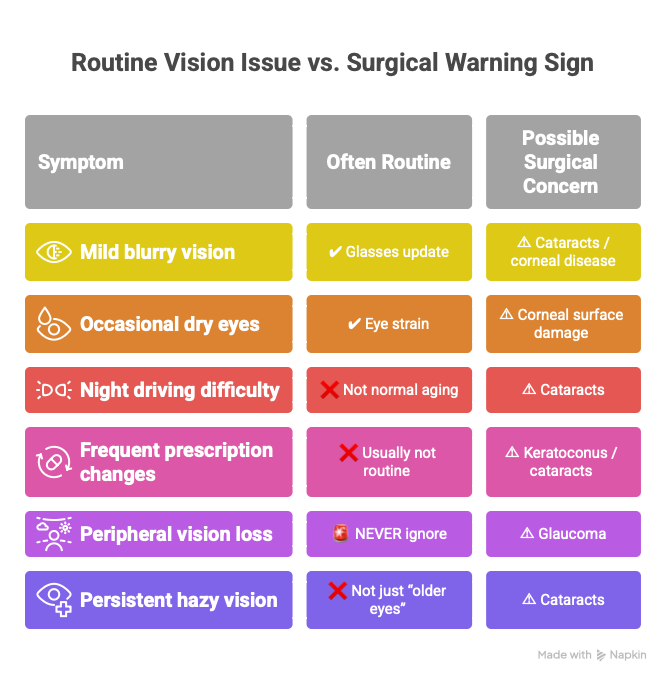
Blurry vision that does not improve with prescription glasses may be an early sign of an underlying eye condition that requires evaluation by an eye surgeon.
This symptom can indicate early cataracts (where the lens inside your eye clouds over), corneal irregularities, or macular changes. An optometrist can prescribe stronger lenses — but only an eye surgeon can remove and replace a clouded lens or reshape the cornea to restore true clarity.
Sign #2: Difficulty Seeing at Night While Driving
Struggling to see road signs, oncoming headlights creating halos, or losing contrast in low light are classic early cataract symptoms. The NEI estimates that more than 24.4 million Americans aged 40 and older have cataracts. Night vision impairment is often the first functional sign and worsens gradually, making it easy to dismiss.
Surgeons assess whether cataract extraction is appropriate through lens density testing and contrast sensitivity measurements, evaluations beyond a standard optometry visit.
Sign #3: Increased Sensitivity to Light
Photophobia, or light sensitivity, has multiple surgical causes: cataracts scatter incoming light abnormally, corneal conditions like keratoconus disrupt how light enters the eye, and elevated intraocular pressure from glaucoma can cause discomfort around bright sources. If sunlight or indoor lighting has become genuinely painful or disorienting, not just mildly uncomfortable, it warrants a surgeon’s assessment, not just tinted lenses.
Sign #4: Frequent Changes in Your Vision Prescription
Needing a stronger prescription every 6 to 12 months is not normal aging. In younger patients, it can signal myopia progression or keratoconus (a condition where the cornea gradually thins and bulges). In older patients, rapidly shifting prescriptions are a known indicator of developing cataracts. An eye surgeon can determine whether lens-based or corneal surgical options will stabilize your vision long-term rather than chasing an ever-changing number.
Quick Fact: Keratoconus affects approximately 1 in 2,000 Americans and can be halted with corneal cross-linking — a minimally invasive surgical procedure unavailable at an optometry office.
Sign #5: Cloudy or Hazy Vision
Cloudiness or a film over your visual field is a hallmark cataract symptom. Many patients describe it as looking through a frosted window or dirty glass that doesn’t clear when they blink. Unlike blurriness that fluctuates, haziness tends to be constant and progressive.
Cataract surgery, one of the safest and most performed surgeries in the U.S. with over 3.8 million procedures annually, replaces the clouded lens with a clear artificial one, often restoring vision patients haven’t had in years.
In our integrated model, the ophthalmologist performs the cataract procedure, and in some cases the optometrist sees the patient for the next-day post-operative visit. This shared follow-up keeps recovery seamless and ensures any concern is flagged quickly within the same care team.
Sign #6: Loss of Peripheral (Side) Vision
This is the glaucoma warning sign most people miss because it disappears silently. Glaucoma damages the optic nerve, typically starting at the edges of your visual field. By the time central vision is affected, significant irreversible nerve damage has already occurred. The Glaucoma Research Foundation estimates that over 3 million Americans have glaucoma, with half undiagnosed.
A surgeon can evaluate intraocular pressure, optic nerve imaging, and visual field tests to determine whether laser treatment or surgical intervention is needed to halt the progression of glaucoma warning signs in vision.
Tip: If you notice you’re bumping into things on your sides, missing objects in your peripheral view, or feeling “tunnel vision,” see an eye surgeon — not just for a pressure check.
Sign #7: You Want to Reduce Dependence on Glasses or Contacts
This is the one sign that isn’t a disease warning; it’s a quality-of-life decision. If you’re a suitable LASIK candidate (stable prescription for at least 2 years, adequate corneal thickness, no dry eye disease), laser vision correction can permanently reduce or eliminate the need for corrective lenses. LASIK has a 96% patient satisfaction rate, making it one of the most successful elective surgeries performed today. An eye surgeon is the only provider qualified to determine candidacy and perform the procedure.

What to Expect During an Eye Surgery Consultation
A surgical consultation is not a commitment to surgery; it is a comprehensive diagnostic evaluation.
Expect corneal topography, intraocular pressure testing, dilated fundus examination, and a detailed review of your visual history. The surgeon will then outline which conditions are present, what stage they are at, and whether surgical, laser, or continued monitoring is the right path for you.
If you were referred internally by one of our optometrists, the ophthalmologist arrives at your consultation already familiar with your chart, imaging, and recent test results. That continuity saves time, avoids duplicate testing, and lets the conversation focus on your treatment plan from the very first visit.
Key Takeaways
- Optometrists correct vision; eye surgeons diagnose and treat structural eye disease
- Blurry vision, unresponsiveness to glasses, night blindness, and peripheral loss are the top eye surgery warning signs
- Glaucoma and cataracts are largely symptom-silent until advanced, but early surgical evaluation saves sight
- LASIK and laser treatments are elective options evaluated exclusively by ophthalmologists
- An eye surgery consultation is diagnostic, not a commitment — it gives you information to make the right decision
- At Albemarle Eye Care, optometrists and ophthalmologists work as one integrated team — patients move from diagnosis to surgical consultation to post-op follow-up without leaving the practice or chasing outside referrals
Conclusion
The question isn’t whether you need surgery, it’s whether you’re seeing the right specialist to find out. An optometrist is an essential first step in eye care, but when symptoms persist, progress, or point to structural disease, an eye surgeon becomes the necessary next one.
At an integrated practice like our Albemarle Eye Care, that next step doesn’t mean a new office, a new chart, or a new wait list — it means the optometrist you already trust connecting you directly with the ophthalmologist down the hall.
Don’t wait for vision loss to become irreversible before asking the harder question: Is this something only a surgeon can fix?
Frequently Asked Questions
Can an optometrist refer me directly to an eye surgeon?
Yes — and at Albemarle Eye Care, you usually don’t have to. Because we are part of US Eye, a vertically integrated eye care network, our optometrists and ophthalmologists work side by side within the same practice. When an optometrist identifies a surgical sign like cataracts, glaucoma, or a corneal disorder, they bring an ophthalmologist into your care directly. There are no outside referrals to chase, no records to transfer, and no waiting on a separate surgical office. In most cataract cases, your optometrist even sees you for the next-day post-operative follow-up, so the same team that diagnosed your condition is the team guiding your recovery.
Will my optometrist stay involved in my care after I’m referred for surgery?
Yes. At Albemarle Eye Care, your optometrist remains part of your care team before, during, and after surgical evaluation. They often perform pre-operative testing, help explain your options, and in most cataract cases see you for the day-after-surgery follow-up. The ophthalmologist performs the surgery and oversees key clinical checkpoints. This co-managed model is one of the main benefits of being a vertically integrated practice.
How do I know if I’m a LASIK candidate without visiting a surgeon?
You cannot. LASIK candidacy requires corneal thickness mapping, pupil measurement, and refractive stability testing, none of which are available through an online screening tool or standard eye exam.
At what stage of cataracts does surgery become necessary?
Surgery becomes appropriate when cataracts interfere with daily function — driving, reading, or working — regardless of how they appear on a slit-lamp exam. The patient’s functional impairment, not the lens’s appearance, drives the surgical decision.
Can children or teenagers show signs that require an eye surgeon?
Yes. Rapidly progressing myopia, keratoconus onset (typically in the teens and twenties), and congenital conditions all require ophthalmologic evaluation rather than routine optometry management.
Are Your Eyes Telling You It’s Time to See an Eye Surgeon?
If any of these seven signs sound familiar, a comprehensive surgical consultation is your clearest next step. Albemarle Eye Care’s board-certified ophthalmologists offer expert evaluations for glaucoma eye surgery, laser eye treatment, and LASIK vision correction surgery across eastern North Carolina.
Because our optometrists and ophthalmologists practice together as one team, you get coordinated diagnosis, surgical care, and follow-up under one roof — no outside referrals, no fragmented records, no extra steps.
Contact us today to schedule your consultation and find out exactly what your vision needs and what’s possible.