
Are you living with diabetes and starting to notice your vision getting cloudier, even with your glasses on?
Table of Contents
If yes, you are not alone. Diabetic patients develop cataracts earlier and faster than the general population. And while that is a serious concern, the good news is this: laser cataract surgery is a proven, safe option for most diabetic patients, including those with well-managed blood sugar levels.
But there is more to the story than just scheduling a procedure. Diabetes changes how your eyes respond, how they heal, and what risks you may face. This guide breaks all of that down in plain language so you can make an informed decision and know exactly what to expect.
How Does Diabetes Affect Your Eyes?
Diabetes does not just affect blood sugar. Over time, high glucose levels damage the small blood vessels throughout your body, including those inside your eyes.
According to the National Eye Institute, diabetic eye disease is the leading cause of new blindness among adults aged 20 to 74 in the United States.
The most commonly known diabetic eye condition is diabetic retinopathy, which affects the retina. But diabetes also directly accelerates lens changes, contributing to earlier and denser cataract formation.
Here is what happens inside the eye when blood sugar is chronically high:
- Excess glucose accumulates inside the lens
- This triggers a process called osmotic stress, which draws fluid into the lens
- The fluid buildup disrupts the transparent structure of the lens
- Over time, the lens turns cloudy, reducing light passage and blurring vision
This process happens faster in diabetic patients than in non-diabetic individuals, sometimes by a decade or more.
Why Cataracts Are More Common in Diabetic Patients
In a healthy lens, glucose is processed efficiently. In diabetic patients, excess glucose gets converted into sorbitol through a pathway involving the enzyme aldose reductase. Sorbitol does not leave the lens easily, so it accumulates and causes swelling and structural damage to lens proteins.
Quick Fact: According to the American Diabetes Association, people with diabetes are 2 to 5 times more likely to develop cataracts than non-diabetic individuals.
Types of Cataracts More Common in Diabetics
| Cataract Type | Description | Common in Diabetics? |
| Nuclear sclerosis | Yellowing and hardening of the lens center | Yes, but also age-related |
| Posterior subcapsular | Affects the back of the lens, near center of vision | Strongly associated with diabetes |
| Snowflake cataract | Rare, acute onset in young patients with Type 1 | Yes, rare but distinct to diabetes |
Posterior subcapsular cataracts are particularly disruptive because they affect the part of the lens most used for reading and seeing in bright light.
What Is Laser Cataract Surgery and How Is It Different?
Traditional cataract surgery uses a handheld blade to make incisions and a manual technique to break up the lens. Laser cataract surgery replaces many of those manual steps with a femtosecond laser, which uses extremely short pulses of light to perform precise, computer-guided cuts.
What the Laser Actually Does
- Creates the corneal incision with consistent depth and size
- Opens the front of the lens capsule (capsulotomy) with round, precise edges
- Pre-softens and pre-fragments the cloudy lens before removal
- Allows the surgeon to make astigmatism-correcting incisions in the same step
The result is more reproducible incisions, reduced ultrasound energy used during lens removal (which matters for diabetic eyes), and better alignment of the replacement intraocular lens (IOL).
Tip for Diabetic Patients: Ask your surgeon specifically about the ultrasound energy reduction with laser technique. Less phacoemulsification energy means less stress on already-vulnerable diabetic corneal cells.
Is Laser Cataract Surgery Safe for Diabetic Patients?
Yes, for the majority of well-controlled diabetic patients, laser cataract surgery for diabetic patients is safe and effective. However, safety is not a blanket statement. It depends on several variables your surgical team will assess before proceeding.
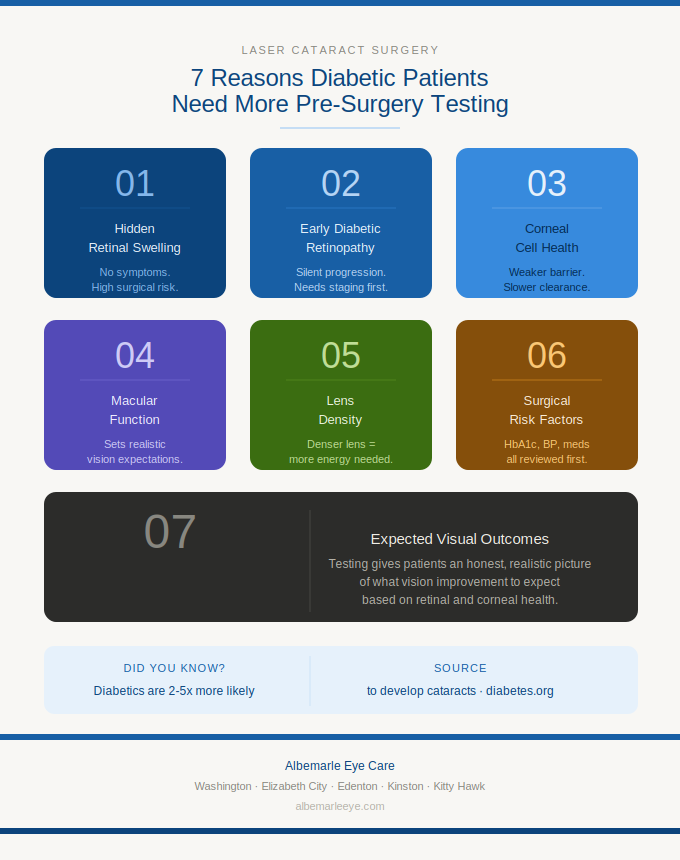
Pre-Surgical Factors That Determine Safety
1. Blood Sugar Control
HbA1c levels matter. Surgeons generally prefer HbA1c below 8.0% before operating. Higher levels increase infection risk, slow healing, and may worsen existing retinal swelling after surgery.
2. Status of Diabetic Retinopathy
If you have active proliferative diabetic retinopathy (PDR) with new abnormal blood vessels, surgery may be more complicated. Your surgeon may need to coordinate care with a retinal specialist before proceeding.
3. Corneal Health
Diabetic patients are more likely to have corneal endothelial dysfunction, meaning the inner layer of the cornea may not pump fluid as efficiently. Your surgeon will evaluate this before surgery.
Special Risks of Cataract Surgery for People With Diabetes
Understanding diabetic eye surgery risks is not about scaring you. It is about giving you the information to have the right conversations with your care team.
Key Risks to Discuss With Your Surgeon
Cystoid Macular Edema (CME)
This is the most significant complication concern in diabetic cataract surgery. CME is swelling in the macula, the central part of the retina responsible for sharp vision. Diabetic patients are at higher risk because the blood-retinal barrier is already compromised. Surgeons often use anti-inflammatory eye drops before and after surgery as a preventive measure.
Slower Wound Healing
Diabetes impairs the body’s healing response. The corneal incisions made during surgery may take longer to seal. This also increases infection risk during the early recovery window.
Worsening Diabetic Macular Edema (DME)
Patients who already have diabetic macular edema before surgery may experience a flare-up of that condition post-operatively. This is why a retinal evaluation is often recommended before scheduling cataract surgery.
Posterior Capsule Opacification (PCO)
PCO, sometimes called a secondary cataract, occurs when the back of the lens capsule becomes cloudy after surgery. This is more common in diabetic patients and can be easily treated with a quick in-office laser procedure called a YAG capsulotomy.
How to Prepare for Laser Cataract Surgery if You Have Diabetes
Preparation is where diabetic patients can most directly influence their surgical outcome. The following steps are practical and clinically meaningful.
Pre-Surgery Checklist for Diabetic Patients
- Get your HbA1c tested and share the result with your eye surgeon at least 4 weeks before surgery
- Schedule a dilated retinal exam to evaluate your retina status before surgery
- Tell your surgeon all medications including insulin, metformin, and any blood pressure medications
- Arrange blood sugar monitoring for the day before and day of surgery, as fasting before surgery can cause fluctuations
- Stop certain medications only if directed. For example, some glaucoma eye drops can interact with anesthesia agents used during surgery
- Coordinate with your endocrinologist or primary care physician so your surgical team has a complete picture of your systemic health
Tip: Do not just aim to pass the pre-op exam. Consistently well-managed blood sugar in the 2 to 3 months before surgery produces meaningfully better healing outcomes.
What to Expect During and After Surgery
For diabetic patients, the surgical experience is largely the same as it is for anyone having laser cataract surgery. However, your care team will pay closer attention to certain health factors before, during, and after the procedure. Knowing what happens at each stage removes the guesswork and helps you show up prepared, not anxious. Here is a clear breakdown of what the process actually looks like.
During the Procedure
Laser cataract surgery typically takes 15 to 30 minutes per eye. You will be awake but sedated with a mild oral medication. Numbing eye drops eliminate pain. The laser maps your eye, performs the incisions, and fragments the cloudy lens. The surgeon then removes the fragments and places a new clear intraocular lens in the same capsule.
For diabetic patients, the surgical team may:
- Take extra time to assess and map the cornea
- Use additional viscoelastic to protect corneal cells
- Recommend a specific IOL type based on your retinal status
Immediately After Surgery
- Vision may be blurry the first day. This is normal.
- Your eye may feel scratchy or sensitive to light.
- You will be given antibiotic, anti-inflammatory, and sometimes anti-VEGF eye drops.
- You will have a follow-up visit within 24 hours.
Recovery Tips for Diabetic Patients After Cataract Surgery
Recovery after cataract surgery diabetes requires more active management than the standard patient experience. Here is what to prioritize:
Practical Recovery Guidance
Blood Sugar Management
Keep blood sugar in your target range throughout recovery. Elevated glucose slows tissue repair and raises the risk of infection at the incision site.
Use Eye Drops Exactly as Prescribed
This is non-negotiable for diabetic patients. Anti-inflammatory drops reduce your risk of CME. Missing doses or stopping early is one of the most preventable causes of poor outcomes.
Protect the Eye
Avoid rubbing the eye. Wear the protective shield at night for at least 1 week. Avoid swimming or putting your face in water for at least 4 weeks.
Monitor for Warning Signs
Contact your surgeon immediately if you notice:
- Sudden decrease in vision
- Increasing redness or pain
- New floaters or flashes of light
- Discharge from the eye
Attend Every Follow-Up Visit
Standard follow-up schedules after cataract surgery are 1 day, 1 week, and 1 month post-op. Diabetic patients may need additional visits to monitor macular status.
Can Diabetes Affect Vision Results After Surgery?
This is one of the most honest questions a patient can ask, and it deserves a straight answer.
For most diabetic patients with good blood sugar control and no significant retinal disease, cataracts in diabetes treatment through laser surgery produces excellent vision improvement. Many patients achieve 20/20 or 20/25 vision after recovery.
However, if diabetic macular edema, significant retinal changes, or optic nerve involvement are present, the final vision outcome depends on the health of those structures, not just the clarity of the new lens. A clear lens can only deliver sharp vision if the retina behind it is able to process that vision properly.
This is why your retinal health evaluation before surgery is as important as the surgical procedure itself.
When Should Diabetic Patients Consider Cataract Surgery?
The right timing depends on three factors working together:
| Factor | What It Means Clinically |
| Visual function impact | Are cataracts significantly limiting daily activities? |
| Retinal stability | Is diabetic retinopathy stable or actively progressing? |
| Systemic control | Is HbA1c at a manageable level (generally below 8.0%)? |
Do not wait until vision is severely impaired. Early-stage surgery is technically easier, allows better surgical visualization, and reduces the complexity of the recovery. At the same time, rushing surgery during a period of poor blood sugar control or active retinal disease increases avoidable risk.
The ideal window is when cataracts are functionally limiting your life and your systemic and retinal conditions are as stable as they can be.
Key Takeaways
- Diabetic patients develop cataracts earlier due to osmotic stress from sorbitol accumulation in the lens
- Laser cataract surgery for diabetic patients is safe when blood sugar is well-controlled and retinal health is evaluated first
- Key diabetic eye surgery risks include cystoid macular edema, delayed healing, and worsening of existing macular edema
- Recovery after cataract surgery diabetes requires strict blood sugar control, precise drop compliance, and additional monitoring visits
- Cataracts in diabetes treatment produces excellent results in most patients with stable retinal health
- Timing surgery when HbA1c and retinal status are both stable produces the best outcomes
Conclusion
Diabetes complicates cataract surgery, but it does not make it impossible, and for most patients, the results are genuinely life-improving. The key is preparation, honest communication with your surgical team, and choosing a center experienced with the specific complexities diabetic patients bring.
Albemarle Eye Care is proud to offer specialized care for diabetic patients considering cataract surgery. With locations in Washington, Elizabeth City, Edenton, Kinston, and Kitty Hawk, our team of experienced cataract surgeons delivers care that accounts for every layer of complexity in your eye health.
Frequently Asked Questions
Can I have laser cataract surgery if I also have diabetic retinopathy?
Yes, in many cases. The decision depends on the severity and stability of your retinopathy. Patients with mild to moderate non-proliferative diabetic retinopathy often proceed safely. Those with active proliferative retinopathy may need retinal treatment first, followed by cataract surgery once conditions are stable.
Will cataract surgery make my diabetic retinopathy worse?
Surgery itself does not cause retinopathy to worsen, but it can unmask or temporarily aggravate diabetic macular edema in patients who already have it. Your surgeon will evaluate your retinal status pre-operatively and may prescribe preventive anti-inflammatory or anti-VEGF treatment.
What type of intraocular lens is best for a diabetic patient?
Monofocal lenses are often recommended first because they have a simpler optical design and are less affected by any macular irregularities common in diabetics. Multifocal and extended-depth-of-focus IOLs can work for select diabetic patients with healthy maculae, but this is discussed case by case.
How long does it take for vision to stabilize after cataract surgery in a diabetic patient?
Most patients see significant improvement within the first week. Full stabilization can take 4 to 8 weeks. In patients managing macular edema or active retinal disease, stabilization may take longer or require additional treatment.
Does insurance cover laser cataract surgery for diabetic patients?
Traditional cataract surgery is typically covered by Medicare and most health insurance plans when there is a documented functional vision impairment. The laser-assisted portion and premium IOL upgrades are often out-of-pocket costs. A detailed financial consultation with your surgical center can clarify your specific coverage.
Are You Ready to See More Clearly?
If you have diabetes and your vision has been getting cloudier, the right time to act is before the condition limits your daily life.
Connect with our team at an advanced laser and cataract center near you to schedule a comprehensive evaluation. Whether you need guidance on timing, retinal assessment, or understanding your surgical options, our laser cataract surgery center is equipped to walk you through every step.
Schedule your laser cataract eye surgery consultation today and take the first step toward clearer, safer vision.