
Cataracts are a natural part of aging, and many people begin to develop them as early as age 40. Cataracts usually develop gradually over time, and you may not notice any changes to your vision in the early stages. With few initial symptoms, regular eye exams are essential to catch conditions like cataracts before they significantly affect your sight.
Table of Contents
A common question patients ask is, does cataract surgery correct vision, or does it only remove the cloudy lens? The answer is both. Modern cataract surgery not only removes the cloudy lens but can also correct existing vision problems like nearsightedness, farsightedness, and astigmatism, giving many patients clearer sight than they have had in years.
Let’s take a deep dive into how cataract surgery corrects vision, what lens options are available, what to expect during recovery, and the realistic results you can expect from this life-changing procedure.
What Are Cataracts?
In the early stages, prescription glasses, magnifying lenses, or brighter lighting can help you see better. But if cataracts begin to impact your quality of life, surgery may be the next step. According to the National Eye Institute, cataract surgery is one of the most common and successful procedures performed in the United States, with about 9 out of 10 people experiencing improved vision after the procedure.
Your eye’s natural lens is normally clear and flexible, helping bend or refract light to allow you to see at various distances. When you develop cataracts, that lens becomes cloudy, making your vision blurry, hazy, or foggy.
The most common cause of cataracts is age. As you grow older, the proteins in your lens begin to break down and clump together, blocking light from passing clearly through the eye. Your risk of developing cataracts can also increase with:
- Family history of cataracts
- Medical conditions such as diabetes
- Smoking
- Eye injury or previous eye surgery
- Radiation treatments on the upper body
- Excessive sun exposure
- Long-term use of certain medications, such as corticosteroids
Age-related cataracts develop gradually, while cataracts in younger people or those with health concerns like diabetes may progress more quickly.
If you have cataracts, you may experience symptoms such as:
- Blurry or cloudy vision
- Double vision in one eye
- Sensitivity to light from lamps, sunlight, or headlights
- Halos around lights
- Trouble seeing well at night
- Faded or yellowed colors
- Frequent changes in glasses prescriptions
How Does Cataract Surgery Improve Vision?
So, does cataract surgery correct vision in a meaningful way? Yes. Cataract surgery improves eyesight by removing the cloudy natural lens and replacing it with a clear artificial intraocular lens (IOL). Because the new lens is custom-selected for your eye, the procedure does more than just clear up cloudiness, it actually refocuses how light enters your eye.
This is why many patients ask, can cataract surgery improve eyesight beyond simply removing cloudiness? In most cases, the answer is yes. The IOL is calculated using precise measurements of your eye, and it can be chosen to correct refractive errors like nearsightedness, farsightedness, or astigmatism. For many people, this means significantly less reliance on glasses or contact lenses.
Vision after cataract surgery is often described as brighter, sharper, and more colorful. The new clear lens replaces the yellow-tinted aging lens, so colors look more vivid and details look crisper.
What Vision Problems Can Cataract Surgery Correct?
Modern cataract surgery vision correction can address several refractive errors at the same time the cataract is removed. Depending on the IOL you choose, cataract surgery can help correct:
- Nearsightedness (myopia): Difficulty seeing objects far away
- Farsightedness (hyperopia): Difficulty seeing objects up close
- Astigmatism: Blurry or distorted vision caused by an irregularly shaped cornea
- Presbyopia: Age-related difficulty focusing on close objects, often noticed in your 40s
Standard IOLs typically correct one distance, usually far vision, while premium IOLs can address multiple ranges of vision. This is one of the most exciting advances in cataract surgery vision correction, because it gives patients the opportunity to reduce or even eliminate their dependence on glasses for many daily tasks.
Can Cataract Surgery Correct Astigmatism?
Yes. Cataract surgery can correct astigmatism using specialized lenses called toric IOLs or through additional procedures performed during cataract surgery.
Astigmatism occurs when the cornea or lens has an irregular curve, causing light to focus unevenly on the retina. A toric IOL is specifically designed to counteract this irregular shape, providing clearer distance vision without glasses.
For patients with mild astigmatism, your surgeon may also use a technique called limbal relaxing incisions during cataract surgery, which can reshape the cornea slightly to reduce astigmatism. Your ophthalmologist will help you determine the best approach based on the type and severity of your astigmatism.
Types of Intraocular Lenses (IOLs)
One of the most important decisions in your procedure is choosing among the available cataract surgery lens options. The IOL you select plays a major role in your vision after cataract surgery, so it is worth understanding how each type works.
Monofocal IOLs
These are the most common and traditional cataract surgery lens options. Monofocal lenses provide clear vision at one distance, usually far. You will likely still need reading glasses for close-up tasks like reading or using your phone. Monofocal IOLs are typically covered by insurance.
Toric IOLs
Toric lenses are specifically designed to correct astigmatism along with the cataract. They can dramatically reduce or eliminate the need for distance glasses in patients with significant astigmatism.
Multifocal IOLs
Multifocal lenses use multiple focusing zones to provide clear vision at near, intermediate, and far distances. They are a popular choice for patients who want to minimize their dependence on glasses for everyday activities. Some patients notice halos or glare around lights at night, especially during the adjustment period.
Extended Depth of Focus (EDOF) IOLs
EDOF lenses create a single, elongated focal point that delivers strong distance and intermediate vision (great for computer work and dashboard reading), with reasonable near vision. They generally produce fewer nighttime visual disturbances than multifocal IOLs.
Accommodating IOLs
These lenses are designed to shift slightly within the eye to mimic the natural focusing ability of a younger lens, providing a range of vision in one IOL.
Light Adjustable Lenses (LAL)
The Light Adjustable Lens is a newer option that allows your surgeon to fine-tune your vision after surgery using UV light treatments. This gives you the unique ability to “test drive” your prescription and adjust until it is just right.
Your ophthalmologist will discuss which cataract surgery lens options best fit your lifestyle, eye health, and visual goals.
Will You Still Need Glasses After Cataract Surgery?
The relationship between cataract surgery and glasses depends largely on the type of IOL you choose. Some patients are able to go without glasses for most activities, while others still rely on them for specific tasks.
Here is a general guide:
- Monofocal IOL set for distance: You will likely need reading glasses for up-close tasks.
- Monofocal IOL set for near vision: You will need glasses for driving and distance.
- Toric IOL: Excellent distance vision for patients with astigmatism, but reading glasses are usually still needed.
- Multifocal or EDOF IOL: Many patients are glasses-free for most daily activities, though some still use readers for very fine print or low-light conditions.
Even with premium lenses, some patients prefer the occasional use of glasses for very detailed work or extended reading sessions. The good news is that cataract surgery and glasses are no longer an either-or choice, you have flexibility based on the IOL you select.
What to Expect Before Cataract Surgery
A few days or weeks before your procedure, your ophthalmologist will perform a thorough eye exam and measure the shape and size of your eyes. These measurements help calculate the exact prescription needed for your IOL.
You may be asked to:
- Stop taking certain medications, such as blood thinners or alpha-blockers, if your doctor recommends it
- Avoid food and drink for about 12 hours before surgery
- Start using antibiotic eye drops a few days before the procedure to reduce the risk of infection
- Arrange transportation, as you will not be able to drive yourself home
This is also the time to ask any final questions about cataract surgery vision correction outcomes, your chosen IOL, and what your recovery will look like.

What Happens During Cataract Surgery?
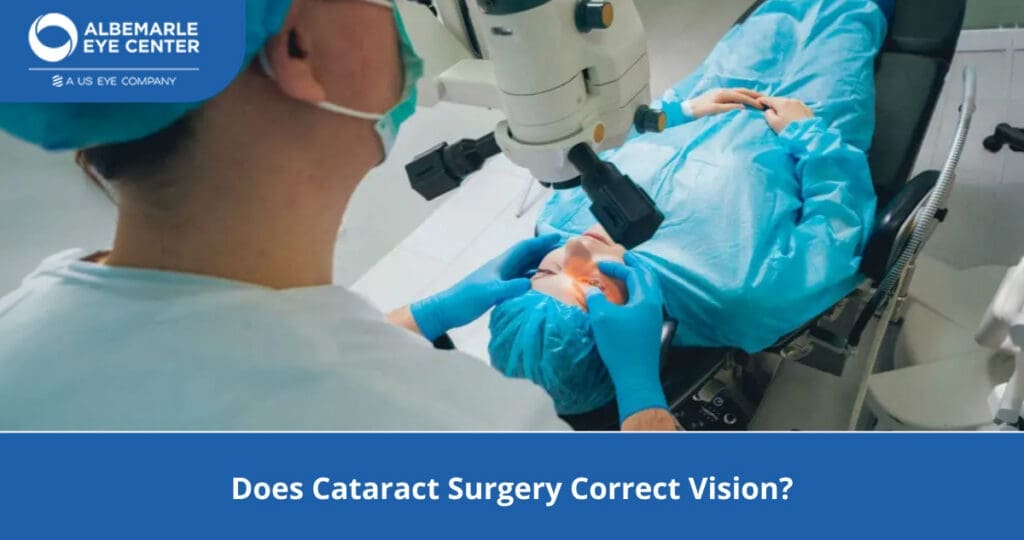
Cataract surgery is an outpatient procedure and usually takes less than an hour. You will be awake during the surgery, but numbing eye drops or a local anesthetic will keep you from feeling anything. You may also receive a mild sedative to help you relax.
Here is what happens during the procedure:
- Numbing: Eye drops or a local anesthetic numb the eye completely.
- Incision: A tiny incision is made at the edge of the cornea, often using a femtosecond laser like the LenSx® system for added precision.
- Lens fragmentation: The cloudy natural lens is broken into small pieces using ultrasound energy (phacoemulsification) or laser technology.
- Lens removal: The fragments are gently suctioned out through the small incision.
- IOL placement: The new artificial lens is folded, inserted through the incision, and positioned in place of the natural lens.
- Closing: The incision is self-sealing, so no stitches are typically required.
The entire process is highly refined and is considered one of the safest procedures in modern medicine.
Recovery After Cataract Surgery
Recovery is generally quick and comfortable. Many patients notice improved vision within 24 hours, though full healing takes several weeks.
In the days and weeks after surgery, you can expect to:
- Use prescription eye drops to prevent infection, reduce swelling, and control eye pressure
- Visit your eye doctor 1 to 2 days after surgery for a follow-up exam
- Experience mild itching or a gritty sensation (avoid rubbing your eye)
- Wear a protective eye shield, especially while sleeping, for several days
- Notice that colors appear brighter and more vivid
- Heal fully within about 8 weeks
You should contact your ophthalmologist immediately if you experience:
- Vision loss
- Persistent pain that does not respond to medication
- Significantly red eyes
- Flashes of light
- A sudden increase in floaters
Realistic Expectations After Cataract Surgery
While cataract surgery is highly successful, it is helpful to set realistic expectations. Vision after cataract surgery often becomes the clearest it has been in years, but the experience varies based on your eye health, IOL choice, and existing conditions.
Here is what to keep in mind:
- It takes time. Your brain needs time to adapt to your new lens, especially with multifocal or EDOF IOLs. Full visual adjustment can take several weeks to a few months.
- Some glare or halos are normal at first. These usually fade as your eye heals and your brain adapts.
- Other eye conditions still matter. If you have macular degeneration, glaucoma, or diabetic retinopathy, your final vision will depend on the health of the rest of your eye, not just the lens.
- Both eyes may be done separately. Most surgeons treat one eye at a time, usually 1 to 2 weeks apart, so each eye can heal before the next procedure.
The vast majority of patients are very satisfied with their results, often calling it life-changing.
Risks and Complications of Cataract Surgery
Cataract surgery is considered very safe, but as with any surgical procedure, there are some risks to be aware of. Most complications are rare and treatable when caught early. Potential risks include:
- Infection (endophthalmitis): Very rare but serious
- Inflammation or swelling of the cornea or retina
- Increased eye pressure that may require treatment
- Retinal detachment, which is uncommon but requires prompt care
- Dislocation of the IOL, which may require repositioning
- Posterior capsule opacification (PCO): A common, easily treated clouding of the lens capsule that can occur months or years after surgery
- Residual refractive error, meaning some patients may still need glasses or a touch-up procedure
According to the American Academy of Ophthalmology, serious complications from cataract surgery are uncommon, and most patients recover with significantly improved vision.
Your ophthalmologist will review your personal risk factors and explain how they apply to your situation.
Frequently Asked Questions
Can cataract surgery fix astigmatism permanently?
Yes. Toric IOLs correct astigmatism during cataract surgery, and because the lens remains in the eye permanently, the correction is typically long-lasting.
Do multifocal lenses eliminate the need for glasses?
Multifocal IOLs greatly reduce dependence on glasses, though some patients may still need them for fine print or prolonged reading.
Why is my vision still blurry weeks after cataract surgery?
Mild blurry vision during healing is normal. Persistent blurriness may result from dry eye, swelling, or a secondary cataract, all of which are usually treatable.
Is laser cataract surgery better than traditional cataract surgery?
Laser-assisted surgery offers added precision for certain patients, especially for astigmatism correction and premium lenses, but traditional surgery is also highly effective.
Can cataract surgery improve night driving vision?
Yes. Cataract surgery often reduces glare, halos, and low-light vision problems, making night driving significantly clearer and safer.
Clear Vision with Cataract Surgery
Modern cataract surgery does far more than remove cloudiness, it offers a unique opportunity to improve your overall sight with advanced cataract surgery lens options and personalized treatment plans. If your cataracts are causing vision problems and interfering with your daily life, book an appointment with Albemarle Eye Center to discuss the best options for your needs.