

Have you been told you need laser cataract surgery on both eyes and now you’re wondering how long this whole process is actually going to take?
Table of Contents
You are not alone. This is one of the most common questions patients ask before their procedure. And it is a fair one. After all, your eyes are essential to so many aspects of your life, from seeing your loved ones’ faces to driving, reading, and carrying out daily activities. Knowing the timeline helps you feel more in control, confident, and at ease. This guide walks you through everything you need to know from the recommended waiting period between surgeries to what your vision will feel like in between, what affects your timing, and exactly when to call your doctor.
What Is the Recommended Time Gap Between Cataract Surgeries?
When laser cataract surgery is required for both eyes, it is typically performed over two separate sessions rather than all at once. By treating one eye at a time, your surgeon can monitor your initial recovery before proceeding with the second. While there is no ‘one-size-fits-all’ timeline, several factors influence the ideal window between procedures.
So what is the timeframe between cataract surgeries? The short answer: most surgeons recommend waiting 1 to 4 weeks between the two procedures. However, this is not a fixed rule. Your surgeon evaluates how well your first eye heals and adjusts the second surgery’s timing accordingly.
Standard 1–2 Week Interval Explained
For most healthy adults with uncomplicated cataracts, the standard gap between surgeries is 1 to 2 weeks. This window is based on decades of clinical outcomes. It gives enough time for the first eye to stabilize and for your surgeon to confirm the lens prescription before applying similar parameters to your second eye.
According to the American Academy of Ophthalmology, the vast majority of cataract surgeries in the U.S. are performed as separate procedures on different days, with this 1–2 week gap being the most common approach.
Quick Fact: Cataract surgery is the most commonly performed surgical procedure in the United States. According to the National Eye Institute, more than 3.8 million cataract surgeries are performed annually in the U.S.
When Surgeons Recommend Shorter or Longer Gaps
Some patients may be scheduled sooner, within a few days, if there is a strong medical or functional reason, such as only one functioning eye or an occupation that requires immediate binocular vision.
Others may wait 4 to 6 weeks, particularly if:
- The first eye showed unexpected inflammation or pressure changes
- The lens power prescription needs additional fine-tuning
- There are underlying conditions like diabetic retinopathy or glaucoma that complicate healing
- The patient experienced slow visual recovery after the first surgery
Your surgeon’s judgment here is not arbitrary. It is based on direct observation of how your eye is responding.
Why Is There a Waiting Period Between Eye Surgeries?
There is a very practical reason why doctors do not operate on both eyes the same day in most cases. The waiting period exists to protect you. Understanding why surgeons wait between cataract surgeries removes the frustration of the delay and replaces it with informed appreciation.
Healing and Recovery Monitoring
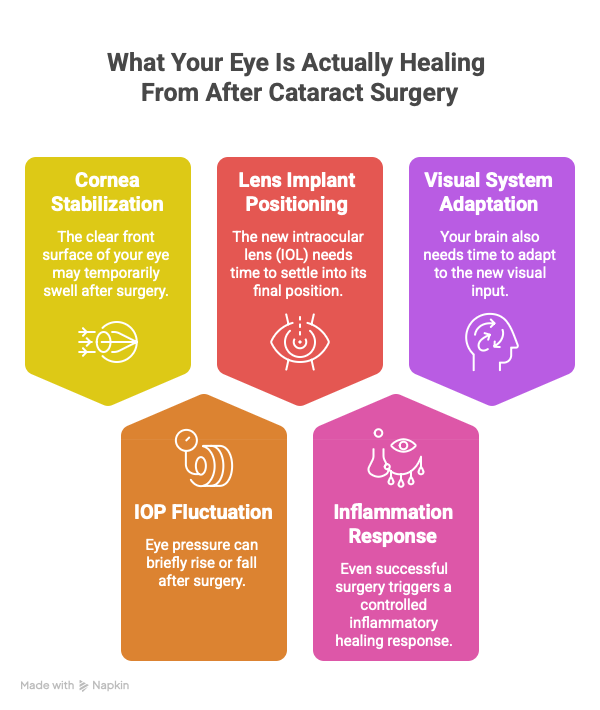
After cataract surgery, your eye goes through a measurable healing process. Intraocular pressure (IOP) may fluctuate. The cornea may experience mild swelling. The immune response is briefly elevated. These are normal responses, but they must be monitored before subjecting the second eye to the same surgical stress.
If both eyes were operated on simultaneously and a complication arose such as endophthalmitis (a rare but serious eye infection), both eyes could be affected. By separating the procedures, any such risk is contained to one eye at a time. The rate of endophthalmitis after cataract surgery is estimated at 0.04% to 0.09% per eye. Small risk, but the stakes are your vision.
Adjustments Based on First Eye Outcome
Here is something most patients do not realize: the results from your first eye surgery directly inform your second surgery.
Your surgeon will measure the refractive outcome — meaning, how clearly your first eye sees after the implanted lens settles. If your vision lands slightly off-target (which occasionally happens due to natural variation in eye anatomy), your surgeon can recalculate and refine the intraocular lens (IOL) power for the second eye.
This is a significant clinical advantage. Without this adjustment window, both eyes could end up with a lens prescription that is not quite right.
Tip for Patients: Keep your follow-up appointments between the two surgeries. This is when your surgeon gathers the data they need to optimize your second procedure. Missing these appointments can delay your second surgery.
Can Cataract Surgery Be Done on Both Eyes at Once?
The question of whether can both eyes be done at the same time for cataract surgery does have a clinical answer and it is nuanced.
Immediate Sequential Bilateral Cataract Surgery (ISBCS)
Immediate Sequential Bilateral Cataract Surgery, or ISBCS, refers to performing surgery on both eyes in a single session, typically on the same day, often with a short break between the two eyes.
This approach is practiced in select cases, particularly in countries with limited surgical access or for patients with high medical risk from anesthesia who cannot safely undergo two separate procedures.
Pros and Cons
ISBCS has documented advantages:
- Shorter overall recovery period
- Fewer total medical visits
- Faster return to driving and work
- Lower cumulative cost in some healthcare systems
However, it also carries increased risk:
- No opportunity to adjust IOL power based on first eye results
- If an infection or complication occurs, both eyes are exposed
- Bilateral simultaneous complications, though rare, can result in visual loss in both eyes
For this reason, most ophthalmologists in the United States do not routinely perform ISBCS outside of specific clinical criteria. The American Academy of Ophthalmology has noted that while ISBCS may be appropriate in select cases, the standard of care in the U.S. remains separate sequential surgeries.
What to Expect Between First and Second Eye Surgery
The days or weeks between your two surgeries are not just a waiting period. They are a transitional phase. Knowing what to expect helps you prepare practically and emotionally.
Vision Imbalance and Adjustment
One of the most common experiences patients report between the two surgeries is anisometropia — a significant difference in prescription between the two eyes. After the first eye receives a clear new lens, it may see very differently from the untreated eye, which still has a cloudy cataract.
This imbalance can cause:
- Blurred or doubled vision when using both eyes together
- Difficulty with depth perception
- Headaches or eye strain
This is a known, temporary condition. Your brain will struggle to fuse two very different images. For most patients, the solution is simply to wait until the second surgery is done. Wearing your old glasses may not help much during this period. Your surgeon may recommend a temporary lens solution or simply advise patience.
Quick Fact: Vision imbalance between the two eyes is the most reported challenge during the interval between cataract surgeries. It typically resolves within days of the second surgery.
Daily Activities — Driving, Work, Screens
How soon can you see after laser cataract surgery? Most patients notice improvement in the operated eye within 24 to 48 hours, though full stabilization takes 2–6 weeks.
Between surgeries:
- Driving: Most patients can drive once the first eye has cleared and the surgeon approves — typically within 1 week. However, if vision imbalance is significant, driving may still feel uncomfortable or unsafe. Always get explicit clearance from your doctor.
- Work: Desk work and computer use are generally allowed within a few days, depending on your job. Jobs requiring heavy lifting or dusty environments may need more time off.
- Screens: Screen use is generally safe quickly, but dry eye symptoms may make extended screen time uncomfortable initially.
Factors That Affect Surgery Timing
The cataract surgery second eye timing is not one-size-fits-all. Multiple factors shape when your surgeon schedules the second procedure.
Age and Eye Health
Older patients or those with age-related macular degeneration (AMD) may require additional evaluation time between surgeries. The healing process is generally the same, but comorbidities may slow recovery or change the clinical picture.
Presence of Conditions Like Glaucoma
Patients with glaucoma face additional considerations. Cataract surgery itself can sometimes lower intraocular pressure, which is beneficial for glaucoma patients but this effect must be evaluated in the first eye before planning the second surgery’s approach. Your surgeon may use the interval to reassess pressure-lowering medications.
Lifestyle Needs
A professional musician, truck driver, or someone who is the sole caregiver for a dependent family member may have scheduling needs that influence timing. Surgeons at experienced practices factor in your real-world functional demands, not just the clinical guidelines.

Recovery Timeline After Cataract Surgery
Understanding what your recovery time looks like after cataract surgery helps set realistic expectations.
First 24–48 Hours
- Vision may be blurry, hazy, or have a slight blue tint — this is normal
- Mild discomfort, watering, or sensitivity to light is expected
- You will wear a protective eye shield, especially at night
- Avoid rubbing the eye
1 Week Recovery
- Most patients see significant improvement within the first week
- Prescription eye drops (antibiotic and anti-inflammatory) are used as directed
- Vision continues to stabilize
- Follow-up appointments confirm healing progress
Full Healing Timeline
Full recovery and final lens stabilization typically occur within 4 to 6 weeks per eye. Final glasses prescriptions, if needed, should not be ordered before this window closes.
Tip: Do not rush to order new glasses between the two surgeries. Your prescription will change after the second eye heals. Wait until both eyes are fully settled.
What happens if you delay your second eye cataract surgery beyond the recommended window? Extended delays can prolong vision imbalance and may allow the cataract in the second eye to worsen, making that surgery slightly more complex. There is no emergency if you delay by a few weeks but indefinite delay is not advisable.
When to Contact Your Eye Doctor
Is it safe to have cataract surgery twice?
Absolutely and millions of patients do so safely every year. But safety depends on prompt communication. Contact your eye doctor immediately if, after either surgery, you experience:
- Sudden loss of vision
- Increasing rather than decreasing pain
- Significant redness that worsens after the first day
- Flashes of light or new floaters
- Discharge from the eye
These symptoms are rare but require same-day evaluation. Do not wait for your next scheduled appointment if any of these occur.
Key Takeaways
- The standard gap between cataract surgeries is 1 to 2 weeks, though your surgeon may extend this based on healing outcomes
- Waiting between surgeries is a clinical safeguard — not a logistical inconvenience
- The results of your first surgery allow your surgeon to fine-tune the IOL for your second eye
- Vision imbalance between surgeries is normal and temporary
- ISBCS (same-day bilateral surgery) exists but is not routine practice in the U.S.
- Full recovery per eye takes 4 to 6 weeks; final glasses prescriptions should wait until both eyes are healed
- Delay of the second surgery is manageable short-term but should not be prolonged
Conclusion
Cataract surgery is one of the safest and most successful procedures in medicine and when it is done in two carefully timed stages, the results can be life-changing. The waiting period is not a gap in care. It is part of the care. Every appointment between your first and second surgery is an opportunity for your surgical team to confirm, adjust, and personalize your outcome.
Whether you are two weeks out from your first procedure or just beginning to explore your options, the path to clearer vision is well-charted. The question is not whether you will see better.
The question is: are you working with a team experienced enough to get every detail right?
Frequently Asked Questions
Can I wear contact lenses in the non-operated eye between cataract surgeries?
In some cases, yes, your surgeon may prescribe a contact lens for the non-operated eye to temporarily balance your vision during the interval. This is evaluated on a case-by-case basis and depends on your corneal health and prescription.
Does the type of intraocular lens (IOL) affect how long I wait between surgeries?
Premium lenses such as multifocal or extended depth-of-focus (EDOF) IOLs — may require a slightly longer assessment period after the first surgery, since fine-tuning the power is especially critical when both eyes must work together for near, intermediate, and distance vision.
Will I need reading glasses after cataract surgery on both eyes?
It depends on the lens type selected. Monofocal IOLs generally require reading glasses for near tasks. Multifocal or accommodating IOLs aim to reduce dependence on glasses, but results vary by individual. This is a conversation to have in full before scheduling either surgery.
Is the second cataract surgery typically easier or harder than the first?
Most surgeons report that the second surgery is procedurally similar. The main difference is that your surgical team has already evaluated how your specific eye anatomy responds, which helps refine their approach. Anxiety is often lower for patients the second time, which makes the experience smoother.
Does insurance cover both cataract surgeries, or only one?
Medicare and most major insurance plans in the U.S. cover medically necessary cataract surgery on both eyes when cataracts are diagnosed in both. Coverage for premium lens upgrades (such as toric or multifocal IOLs) typically involves an out-of-pocket cost. Always verify specifics with your insurer before scheduling.
Ready to Talk to an Expert About Your Cataract Surgery Timeline?
If you have been putting off the second step or are still figuring out where to start, why not speak directly with a specialist who can give you a clear, personalized plan for both eyes?
At Albemarle Eye Care, our surgical team has guided thousands of patients through laser cataract surgery across eastern North Carolina. We take the time to understand your vision, your lifestyle, and your timeline, so nothing is rushed, and nothing is left to guesswork.
Contact us today to schedule your consultation at one of our locations in Washington, Elizabeth City, Edenton, Kinston, or Kitty Hawk. Clear vision on both sides is closer than you think.