

You may be ready to rely less on glasses or contact lenses, but choosing a laser vision correction procedure can feel confusing. LASIK is often associated with a quicker initial recovery, while PRK may be recommended when a corneal flap is not the preferred approach. That does not mean one procedure is automatically better than the other.
Table of Contents
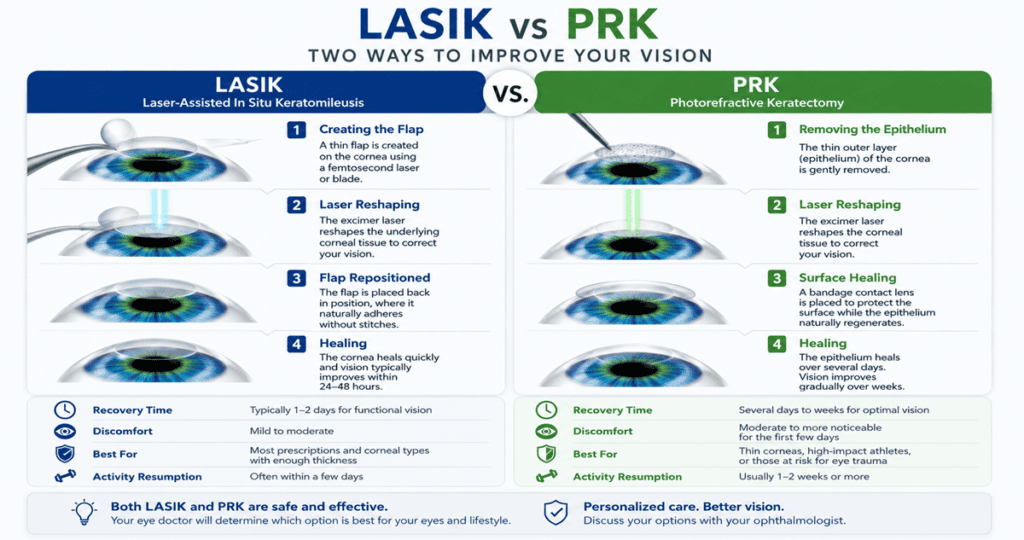
The central difference between LASIK and PRK surgery is how the surgeon reaches the corneal tissue that will be reshaped. LASIK uses a thin corneal flap. PRK removes the cornea’s surface cell layer, which then grows back during recovery. Both procedures use controlled laser energy to reshape the cornea and improve how light focuses inside the eye.
Your eye doctor looks beyond convenience or recovery speed. Corneal thickness and shape, prescription stability, tear-film health, age-related lens changes, medical history, occupation, hobbies, and visual goals all influence the recommendation.
The best laser eye surgery for vision correction is the procedure that provides an appropriate treatment plan for your eye structure, health, and lifestyle—not simply the procedure with the shortest recovery.
What Is LASIK Surgery?
LASIK, or laser-assisted in situ keratomileusis, corrects refractive errors such as nearsightedness, farsightedness, and astigmatism. During the procedure, the ophthalmologist creates a thin flap in the cornea, lifts it, and uses an excimer laser to reshape the tissue underneath. The flap is then returned to its original position.
Because the surface epithelium remains largely intact, vision commonly recovers sooner after LASIK than after PRK. However, the presence of a flap introduces considerations related to corneal thickness, eye trauma, healing, and dry-eye symptoms.
Quick fact: In FDA-sponsored patient-reported outcome studies, more than 95% of participants said they were satisfied with their vision after LASIK. The same research also underscores the importance of discussing possible dry eye and new visual symptoms before surgery.

What Is PRK Surgery?
PRK, or photorefractive keratectomy, also uses an excimer laser to reshape the cornea. Rather than creating a flap, the surgeon removes the cornea’s outer epithelial layer and applies the laser directly to the underlying tissue. A protective bandage contact lens is generally placed over the eye while the epithelium regenerates.
The epithelial layer usually takes approximately three to five days to regrow, although vision may continue to fluctuate as the surface smooths and heals. PRK therefore requires more patience during the early recovery period.
PRK may be considered when a flap-based procedure is less appropriate because of corneal measurements, certain occupational or recreational activities, or other individual findings. It is not automatically suitable for every person who cannot undergo LASIK.
Key Differences Between LASIK and PRK
Clinical reviews have found that LASIK generally provides faster early visual recovery and less initial discomfort, while vision outcomes between LASIK and PRK can be similar at approximately one year. Individual results still depend on prescription, eye health, healing response, technology, and surgical planning.
| Consideration | LASIK | PRK |
| Access to corneal tissue | A thin flap is created and repositioned | The surface epithelial layer is removed |
| Early visual recovery | Usually faster | Usually more gradual |
| Early discomfort | Often milder | Often more noticeable during surface healing |
| Flap considerations | Requires appropriate thickness and flap protection | No corneal flap |
| Follow-up | Postoperative monitoring is required | Postoperative monitoring is required, including surface healing |
| Longer-term results | Can provide strong refractive outcomes in suitable candidates | Can provide comparable refractive outcomes in suitable candidates |
How Eye Doctors Evaluate Patients for LASIK vs PRK
A vision correction evaluation is much more detailed than checking whether you can read an eye chart. Your doctor must determine whether corneal laser treatment can be performed while preserving a suitable corneal structure and supporting healthy healing.
Prescription and vision stability
A changing prescription can make results less predictable. The FDA recommends discussing whether your refraction has changed during the previous year. Pregnancy, breastfeeding, certain medications, diabetes, and younger age can also contribute to prescription fluctuations.
Corneal thickness, curvature, and shape
Corneal topography or tomography creates detailed maps of the cornea. These measurements help identify irregular shapes, thinning, or signs of conditions such as keratoconus. Your doctor also calculates how much tissue would remain after treatment.
Thin corneas do not automatically make PRK appropriate. Your surgeon must evaluate the full corneal profile and proposed treatment depth for either procedure.
Tear-film and ocular-surface health
Dry eye, eyelid inflammation, allergies, and poor tear quality can affect comfort, measurements, and postoperative healing. These conditions may need to be managed before surgery. Both LASIK and PRK can temporarily affect the ocular surface, although their effects may differ between patients.
Age and natural-lens changes
Age alone does not determine candidacy. However, presbyopia; the age-related loss of near focusing ability usually becomes noticeable after age 45. LASIK or PRK may improve a distance prescription without preventing presbyopia or future cataract development. Your doctor may therefore discuss reading glasses, monovision, or lens-based alternatives depending on your age and goals.
For more information about timing, read Albemarle Eye Center’s internal resource, Laser Vision Correction: When Is the Right Time for LASIK?.
Lifestyle and visual priorities
Your doctor may ask about contact sports, military or public-safety work, exposure to dust or eye trauma, night driving, screen use, and the amount of time you can allow for recovery. These practical factors help distinguish a technically possible procedure from one that is appropriate for your daily life.
Consultation tip: Bring your recent glasses prescriptions, medication list, medical history, and details about contact lens use. Your eye care team will tell you how long to discontinue contacts before testing because different lens types can temporarily change corneal measurements.
Am I a Candidate for LASIK or PRK?
A LASIK candidate may have:
- A stable, treatable prescription
- Healthy corneal shape and sufficient tissue
- A well-managed ocular surface
- No medical or eye condition that may interfere with healing
- A preference for faster initial visual recovery
- Realistic expectations about glasses, reading vision, and possible side effects
A PRK candidate may have:
- A stable, treatable prescription
- Corneal measurements for which a surface procedure is preferred
- A lifestyle or occupation in which avoiding a flap may be relevant
- The ability to accommodate a longer initial recovery
- Realistic expectations about discomfort and gradual visual improvement
These are general patterns, not a self-screening checklist. Only a complete examination can establish candidacy.
LASIK vs PRK Recovery Time and Results
LASIK often provides clearer functional vision sooner. Many patients can resume some routine activities relatively quickly, but vision may still fluctuate and the eyes need protection during healing.
PRK recovery is more gradual because the epithelial layer must regenerate. Light sensitivity, tearing, blurred vision, and a gritty sensation may be more noticeable during the first several days. Vision then continues to improve as the surface becomes smoother.
For both procedures, follow-up visits and prescribed eye drops are essential. Final stabilization can take weeks or months, and a rapid improvement does not mean healing is complete. The FDA advises patients to understand that final results may take months and that additional correction is not guaranteed.

Risks and Safety Considerations
LASIK and PRK are elective surgical procedures. Possible concerns include dry eye, glare, halos, starbursts, light sensitivity, fluctuating vision, infection, inflammation, undercorrection, overcorrection, and the continued need for glasses. LASIK also has flap-related risks, while PRK has surface-healing considerations such as delayed epithelial recovery or corneal haze.
Safety begins with appropriate screening, balanced counseling, FDA-approved technology, a qualified surgeon, and consistent follow-up. A responsible recommendation may also be to postpone surgery, manage an eye-surface problem first, or consider a non-corneal alternative.
Key Takeaways
LASIK and PRK reshape the cornea but use different surgical approaches. LASIK generally offers faster early recovery; PRK avoids creating a flap but requires more surface healing. Neither is universally the “best” option.
Your eye doctor’s recommendation is based on your prescription, corneal maps, tear-film health, natural lens, medical history, lifestyle, and expectations. Long-term outcomes can be comparable in appropriately selected patients.
Conclusion:
An online LASIK vs PRK comparison can help you prepare questions, but it cannot show how thick your cornea is, whether your tear film is healthy, or how age-related lens changes may affect your goals.
Albemarle Eye Center provides personalized medical and surgical eye care, including LASIK and PRK evaluations. The practice serves patients through locations in Edenton, Elizabeth City, Kinston, Kitty Hawk, and Washington.
Schedule a LASIK Consultation
Take the next step with a personalized LASIK consultation and vision correction evaluation. An ophthalmologist can assess your eyes, explain whether LASIK, PRK, or another option may be appropriate, and discuss realistic recovery and visual expectations.
Contact Albemarle Eye Center to learn more about laser eye surgery and care through an experienced eye surgery center team.
Frequently Asked Questions
Can LASIK or PRK prevent me from needing reading glasses?
Not necessarily. LASIK and PRK reshape the cornea but do not stop the natural lens from aging. Presbyopia usually affects near vision after age 45, so some patients will still need reading glasses. Monovision may be considered, but it should often be tested with contact lenses first because it can affect depth perception and low-light vision.
Why do I need to stop wearing contact lenses before my evaluation?
Contact lenses can temporarily alter corneal shape and interfere with the measurements used to plan surgery. The required break depends on whether you wear soft, toric, rigid gas-permeable, or hard lenses. Follow the specific schedule provided by your surgeon rather than stopping them based only on a general online recommendation.
Can I have LASIK or PRK after previous eye surgery?
Possibly, but previous cataract surgery, corneal surgery, retinal treatment, or refractive surgery can change the evaluation and treatment plan. Your ophthalmologist will need surgical records when available and may recommend a different enhancement or optical solution.
Does laser vision correction last forever?
The corneal reshaping is intended to be permanent, but the eyes can continue to change with age. Presbyopia, cataracts, prescription shifts, and other eye conditions may affect vision later. Patients should continue routine eye examinations even when they no longer depend on glasses.
Is LASIK or PRK covered by health insurance?
Laser vision correction is generally considered elective and is often not covered by standard medical insurance. Some vision plans provide discounts, and eligible patients may be able to use health savings accounts or flexible spending account funds. Coverage and tax eligibility should be confirmed directly with the relevant plan.