
Have headlights started looking unusually bright? Do you need stronger lighting to read, even with your glasses on? When cataracts interfere with familiar activities, deciding what to do next can feel overwhelming. You may know that surgery can help, but choosing a procedure and replacement lens raises new questions.
Table of Contents
Cataract treatment options include managing early symptoms with updated glasses and lighting adjustments or having surgery to remove the cloudy natural lens. If surgery is appropriate, your ophthalmologist can help select an intraocular lens (IOL) based on your eye health, astigmatism, daily activities, and preferences about wearing glasses. No single lens is best for everyone.
At Albemarle Eye Center, Nikhil Swarup, M.D., is a fellowship-trained surgeon specializing in cataract, refractive, and minimally invasive glaucoma procedures. His clinical background includes an interest in advanced intraocular lens technology and helping patients reduce their dependence on glasses.
This guide explains available treatment approaches, what to consider when selecting a replacement lens, and which questions to ask before deciding.
What Cataract Treatment Options Are Available?
A cataract develops when the eye’s natural lens becomes cloudy, causing symptoms such as blurred vision, glare, and faded colors. Treatment depends on how much these changes affect daily life.
Managing Early Cataract Symptoms
If your cataract is mild, your ophthalmologist may recommend monitoring it while you make practical adjustments. These can include updating your glasses prescription, using brighter reading lights, trying magnification, or wearing anti-glare sunglasses.
Such measures may help you function more comfortably, but they do not remove or reverse a cataract. No eye drop has been proven to dissolve an age-related cataract. According to the National Eye Institute, surgery is the only way to remove the cloudy lens.
Because several eye conditions can cause similar symptoms, you may also find our guide to cataracts, macular degeneration, and presbyopia helpful.
Knowing When Surgery May Be Appropriate
You do not necessarily need surgery immediately after diagnosis. The decision often depends on whether cataracts interfere with driving, reading, hobbies, or other important activities. Your ophthalmologist may also recommend surgery to allow a clearer retinal examination.
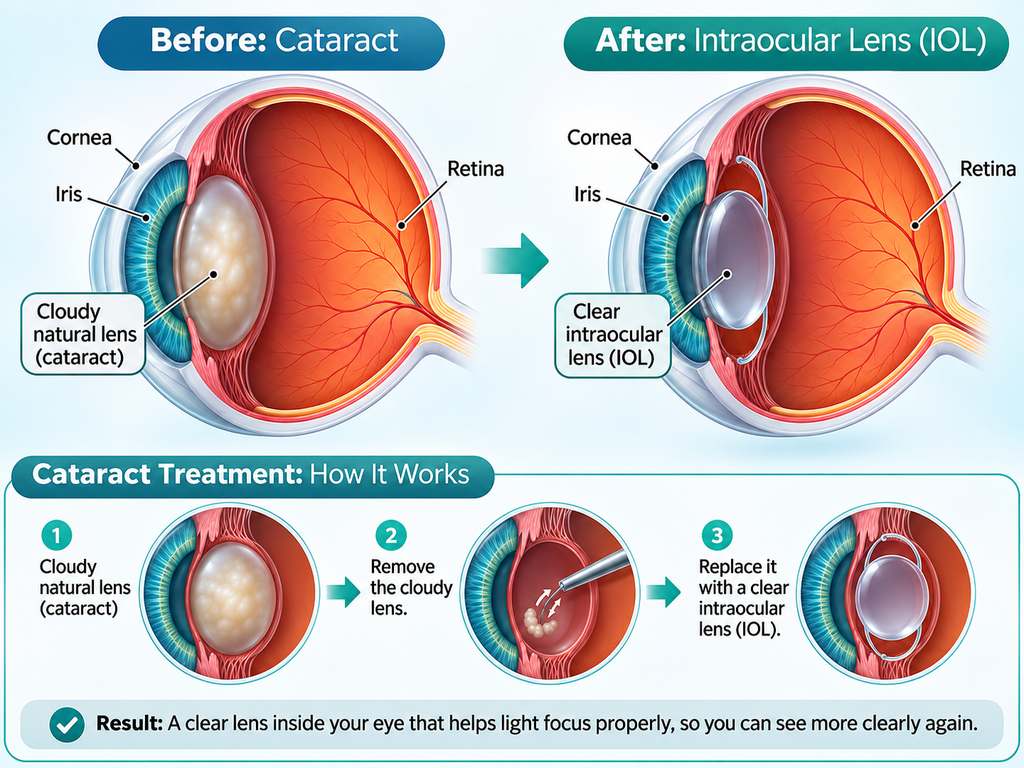
During surgery, the cloudy lens is removed and generally replaced with a clear artificial intraocular lens (IOL). The National Eye Institute reports that approximately 9 out of 10 people see better after cataract surgery. Individual results still depend on eye health and other factors.
What Are the Different Cataract Surgery Approaches?
The two main approaches are conventional cataract surgery (phacoemulsification) and femtosecond laser-assisted cataract surgery. Both remove the cloudy natural lens and replace it with an artificial lens. Your ophthalmologist recommends a technique after evaluating your eyes and discussing its benefits and limitations.
Conventional Cataract Surgery
In conventional phacoemulsification, an ophthalmologist makes a small incision and uses an ultrasound instrument to break apart and remove the cloudy lens. A replacement IOL is then implanted. This widely established procedure is generally performed on an outpatient basis.
Laser-Assisted Cataract Surgery
Femtosecond laser-assisted cataract surgery uses a laser for selected steps, such as creating incisions or fragmenting the natural lens. Albemarle Eye Center offers LenSx laser cataract surgery.
Laser assistance can provide technical benefits in some circumstances, but it does not automatically produce better vision. The American Academy of Ophthalmology notes that studies have not consistently shown better overall outcomes or fewer complications than conventional surgery.
Quick Tip: The surgery technique and replacement lens are separate decisions. Ask your surgeon about both rather than assuming one determines the other.
Understanding the Types of Cataract Surgery Lenses
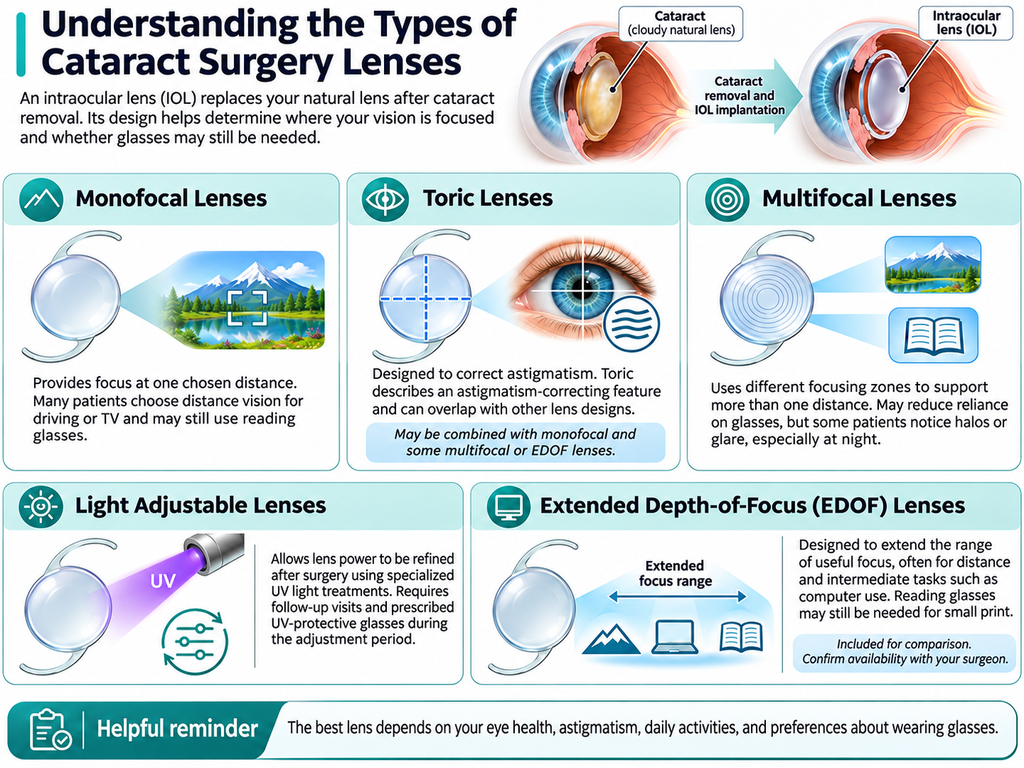
An IOL replaces your natural lens after cataract removal. Its design helps determine where your vision is focused and whether glasses may still be needed. Albemarle Eye Center lists monofocal, toric, multifocal, and Light Adjustable Lens technologies among its cataract services.
Monofocal Lenses
A monofocal IOL provides focus at one chosen distance. Many people select distance focus for driving or television and continue using reading glasses. Others prefer a near-vision target. These lenses remain a widely used option for different visual priorities.
Toric Lenses
Toric IOLs address corneal astigmatism, which occurs when the cornea’s curvature affects how light focuses. A suitable toric lens may reduce remaining astigmatism, although glasses may still be needed.
Importantly, “toric” describes an astigmatism-correcting feature, not a separate focusing range. Toric correction can be included in monofocal and certain multifocal or EDOF lens designs, so these categories can overlap. Your measurements help determine whether toric correction is appropriate.
Multifocal Lenses
Multifocal IOLs use different focusing zones to support vision at multiple distances. They may reduce reliance on glasses, but some patients notice halos, glare, or reduced contrast, particularly at night. Ask how these potential effects relate to your driving habits and eye health.
Light Adjustable Lenses
The Light Adjustable Lens (LAL) allows the surgeon to refine lens power after the eye has healed. Adjustments use specialized ultraviolet (UV) light, followed by treatments that finalize the lens power. Patients need additional appointments and must wear prescribed UV-protective glasses during the adjustment period.
Albemarle describes the process in its article about how the Light Adjustable Lens works. It is not suitable for everyone.
Extended Depth-of-Focus (EDOF) Lenses
EDOF lenses are designed to extend the range of useful focus, often supporting distance and intermediate tasks such as computer use. You may still need reading glasses for small print, and some designs can cause visual disturbances. EDOF is included here for comparison; Albemarle Eye Center’s published cataract service page does not currently list it as an available lens option. Confirm availability directly with the practice.
Cataract Lens Options
| Lens option | Typical focus or purpose | What to ask about |
| Monofocal | One selected distance | Will I need reading or distance glasses? |
| Toric (astigmatism correction) | Reduces astigmatism; may overlap with other lens designs | Is my astigmatism suitable for toric correction? |
| Multifocal | Vision at multiple distances | What is my risk of halos or night glare? |
| EDOF (general comparison) | Extended range, often distance and intermediate | Will I need reading glasses, and is this option available here? |
| Light Adjustable Lens | Lens power refined after surgery | How many light-treatment visits and UV-glasses precautions are required? |
The table describes common lens features rather than ranking lenses or promising results. For additional background, see the American Academy of Ophthalmology’s IOL overview.
How to Choose Cataract Surgery Options for Your Needs
When people ask, “Which cataract surgery lens is right for me?”, the best starting point isn’t a brand name. It is a discussion about your vision priorities, medical history, and expectations.
Consider Your Daily Activities
Think about where clear vision matters most. Do you read for long periods, use a computer, enjoy detailed hobbies, or drive frequently? Tell your surgeon which distances are important. Your preferences can influence both lens design and the chosen focusing target.
Talk Specifically About Night Driving
If you often drive after dark, ask how each eligible lens might affect halos around headlights, glare, and contrast in low light. Some multifocal designs can produce more noticeable visual disturbances; a monofocal lens may better match the preferences of patients who prioritize night driving. Your surgeon should evaluate these trade-offs for your particular eyes rather than offering a universal recommendation.
Discuss Your Tolerance for Glasses
Some people are comfortable using reading glasses; others prefer to reduce glasses use. Neither preference is wrong. Ask which tasks may still require glasses with each lens, even if it is designed to support more than one distance. No IOL can guarantee complete freedom from spectacles.
Review Astigmatism and Earlier Eye Surgery
Corneal astigmatism can influence lens selection. Previous LASIK or PRK also matters because these procedures change corneal measurements used to calculate lens power. Bring records of earlier surgery, if available, and tell your ophthalmologist about any past vision correction.
Account for Other Eye Conditions
Glaucoma, macular degeneration, diabetic retinal disease, and dry eye may affect the outcome or appropriateness of particular lenses. Dry eyes can also interfere with accurate preoperative measurements. Your surgeon may recommend further testing or treatment before finalizing a lens choice.
Understand Costs Before Deciding
The best cataract treatment option is the one medically appropriate for your eyes and aligned with your priorities, not necessarily the most expensive choice. Medicare may cover medically necessary cataract surgery with a conventional IOL, while elective features designed to reduce dependence on glasses may involve additional charges. Ask for an individualized estimate showing covered services and out-of-pocket costs.
What Happens at a Cataract Consultation?
A cataract consultation helps your ophthalmologist determine whether surgery is appropriate and plan the procedure. The evaluation may include vision testing, an examination of the lens and retina, and detailed measurements of the cornea and eye to calculate IOL power.
Be prepared to explain which activities have become difficult and whether you have a history of glaucoma, retinal disease, dry eye, LASIK, or other eye procedures. Your clinician may discuss recovery expectations, surgical risks, and alternatives based on your results.
Questions to bring to your appointment:
- Is my cataract the main reason for my reduced vision?
- Should I consider surgery now or continue monitoring?
- Which IOL designs are suitable for my eyes?
- What glasses might I need afterward?
- What are the risks, follow-up requirements, and costs?
These questions help make the decision personal, not based solely on technology.
What Happens After Cataract Surgery?
Most patients go home on the day of surgery and need someone else to drive them. Your care team will provide instructions for eye drops, protective eyewear, follow-up visits, and temporary activity restrictions.
Mild irritation, blurry vision, or light sensitivity may occur during healing. Recovery varies, so follow your surgeon’s specific guidance instead of another patient’s timeline.
Although cataract surgery is generally effective, complications are possible. Contact your eye doctor promptly if you experience sudden vision loss, severe pain, marked redness, flashes, or a sudden increase in floaters.
Key Takeaways
- Surgery is the only established way to remove a cataract; mild symptoms may be managed temporarily without surgery.
- Conventional and laser-assisted surgery are both established approaches.
- Lens choices affect focusing range, astigmatism correction, and potential glasses use.
- Lifestyle, eye health, previous surgery, and cost all influence the decision.
- A personalized consultation matters more than choosing a lens based on reputation alone.
Choose With Clear Expectations
Exploring cataract treatment options should leave you better prepared, not pressured to make an immediate decision. Understanding how a procedure works, what each IOL is designed to do, and which trade-offs matter to you can make your consultation more productive.
Albemarle Eye Center offers cataract care and lens technologies that can be discussed in the context of your individual eye health. Your ophthalmologist can help you develop a plan with realistic expectations.
Frequently Asked Questions
Can Cataracts Come Back After Surgery?
No, cataracts cannot return once the cloudy natural lens is removed. However, some patients develop posterior capsule opacification (PCO), which causes blurry vision and can be treated with a laser procedure.
Is Cataract Surgery Painful?
Cataract surgery is generally not painful because numbing eye drops are used. Patients may experience mild pressure during the procedure or temporary discomfort afterward.
Can Both Eyes Have Cataract Surgery on the Same Day?
Cataract surgery is typically performed on each eye separately. Your ophthalmologist will determine the appropriate interval between procedures based on your healing and individual eye health.
Will Colors Look Brighter After Cataract Surgery?
Some patients notice brighter, more vibrant colors after cataract surgery because the cloudy, yellowed natural lens is replaced with a clear artificial lens.
Can Younger Adults Develop Cataracts?
Yes. Although cataracts are more common with aging, younger adults can develop them due to eye injuries, certain medical conditions, prolonged steroid use, or genetic factors.
Discuss Your Cataract Treatment Options With Albemarle Eye Center
If cataracts affect your daily routine, a personalized evaluation can help you understand your options. Albemarle Eye Center provides cataract services, including surgery and replacement lens options.
To explore care in northeastern North Carolina, connect with a cataract surgeon in Elizabeth City through Albemarle Eye Center.
Schedule an appointment to discuss your symptoms, eye health, and treatment goals.
Medical disclaimer: The information offered in this blog is not intended to substitute for expert medical advice. Always seek a qualified healthcare professional for any questions or concerns about your specific medical condition.